Meta has unveiled its next-generation artificial intelligence (AI) model, Muse Spark. This groundbreaking model is the first in a new series of large language models (LLMs) developed by Meta’s Superintelligence Research Lab (MSL), established through extensive talent acquisition and investment.
In a blog post on Wednesday, Meta introduced Muse Spark as the inaugural model in its cutting-edge AI language series.
The company highlighted that while Muse Spark is engineered for speed and efficiency, it also boasts impressive reasoning capabilities for complex questions in science, mathematics, and health. Meta also revealed that development of the next-generation model is already underway.
Meta had previously released its flagship Llama series as open-source. However, after the Llama 4 series, announced last April, fell short of performance expectations, the company pivoted to a closed-source strategy.
In response, Meta launched MSL last year under the leadership of former Scale AI Chief Executive Officer (CEO) Alexander Wang. The lab began developing a closed AI model codenamed Avocado, which keeps key components like weights confidential.
Muse Spark represents the first closed AI model to emerge from the Avocado series.
Meta plans to initially offer a private preview of the model through an application programming interface (API) to select partners. The company is also considering releasing future versions as open-source.
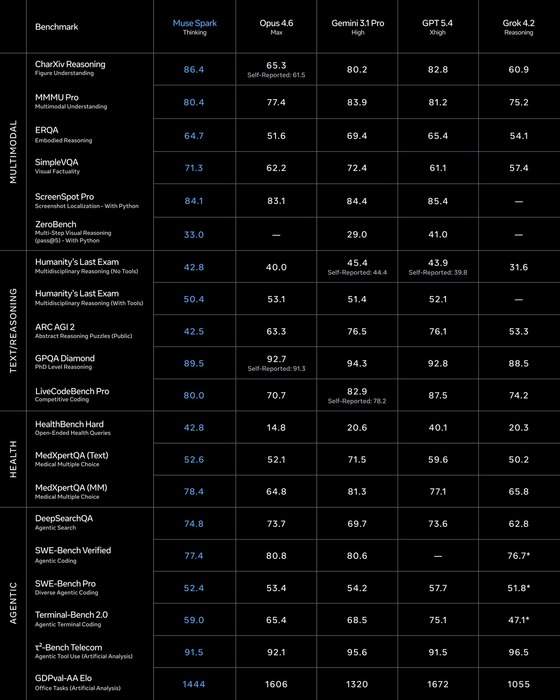
A standout feature of Muse Spark is its Deliberation Mode, allowing multiple agents to perform inference tasks simultaneously. In tests, Muse Spark demonstrated performance levels rivaling other models’ inference modes, including Google’s Gemini DeepThink and OpenAI’s GPT Pro.
In the inference domain, Muse Spark achieved an impressive 50.2% accuracy rate, outperforming Gemini 3.1’s DeepSync at 48.4% and GPT-5.4 Pro at 43.9%.
The model also showed competitive performance across various benchmarks. In Humanity’s Last Exam, featuring 2,500 expert-level problems in math, physics, and chemistry, Muse Spark achieved a 58% accuracy rate. It also scored 38% accuracy in Frontier Scientific Research.
As of today, users can access Muse Spark through the Meta AI app on Apple devices and the meta.ai website. The model is designed to support complex reasoning and multimodal tasks on both platforms.
This advancement enables Muse Spark to address a wide range of inquiries, from simple questions requiring quick answers to complex problems demanding intricate reasoning.
Notably, Muse Spark excels in multimodal recognition, allowing it to understand not just text input but also the context users are experiencing. For example, if a user runs the Meta AI app and photographs a snack display at an airport, the AI can rank products based on their protein content.
Meta suggests that if Muse Spark powers Meta AI in its smart glasses, it could evolve into an assistant that more accurately perceives and understands the surrounding environment.
Muse Spark also demonstrates impressive performance in visual coding, enabling users to create custom websites or mini-games with simple prompts.
Meta plans to integrate Muse Spark across its ecosystem, including Instagram, Facebook, WhatsApp, and its AI glasses, in addition to Meta AI.