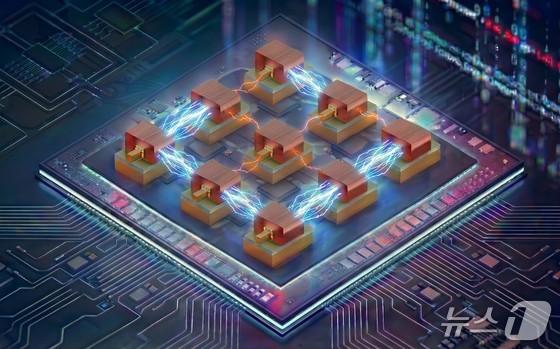
On Wednesday, the Korea Advanced Institute of Science and Technology (KAIST) announced a breakthrough in next-generation computing hardware. A joint research team, led by Professors Choi Yang-kyu and Kim Sang-hyun from the School of Electrical Engineering, has successfully developed an Oscillator-Based Ising Machine using conventional silicon semiconductor processes.
This groundbreaking achievement marks the world’s first scalable complementary metal-oxide-semiconductor (CMOS) Ising machine composed entirely of silicon-based transistors. The innovation addresses the scalability and reliability limitations of traditional oscillator-based Ising machines, opening doors for a low-power, high-density specialized computing platform.
As big data and artificial intelligence (AI) continue to reshape industries, the challenge of finding optimal solutions among countless possibilities has become a critical focus. In response, researchers have proposed hardware implementations of the Ising model from statistical physics.
Previous Ising machines struggled with precise control of minute frequency variations between oscillators and had limited interconnections, hampering their ability to solve complex problems.
To overcome these hurdles, the KAIST team pioneered a novel approach, implementing both oscillators and their connecting couplers as single silicon transistors – the fundamental switching elements in semiconductors.
This innovation significantly reduced frequency discrepancies between oscillators, enabling stable synchronization. It also allowed for more precise weighting in multi-state coupling implementations, dramatically enhancing both the expressive power of the Ising model and its solution exploration capabilities.
The team successfully applied this technology to solve a classic combinatorial optimization problem: the maximum cut problem, which involves maximizing connections when dividing a network into two groups.
This breakthrough has far-reaching implications across various sectors, including logistics route optimization, financial portfolio construction, and semiconductor circuit design.
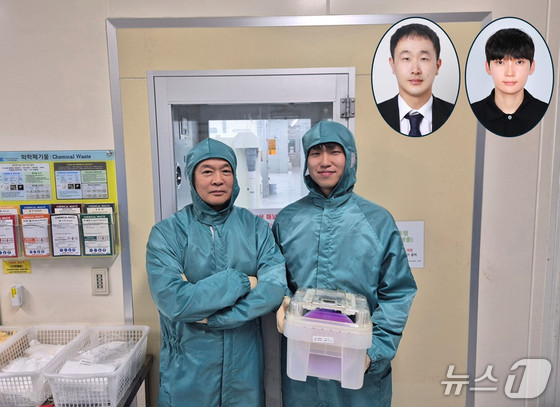
A key advantage of this research is its utilization of standard CMOS processes currently employed in the semiconductor industry, without requiring special materials or non-standard techniques. The team emphasized that this approach enables mass production and commercialization using existing semiconductor production lines, eliminating the need for additional capital investment.
Professor Choi highlighted the significance of their work, stating that the research has yielded Ising machine hardware that achieves both scalability and precision by implementing oscillators and couplers with silicon devices. It anticipates its application in various industries requiring large-scale combinatorial optimization, such as automated semiconductor design, communication network optimization, and resource allocation.
The research, co-authored by KAIST Doctor of Philosophy (PhD) candidates Yoon Sung-yoon and Kim Jun-pyo, has been published in the prestigious scientific journal Science Advances.
This study was supported by several national initiatives, including the Next-Generation Intelligent Semiconductor Technology Development Project, the National Semiconductor Research Laboratory’s Core Technology Development Project, and the Processing-in-Memory (PIM) AI Semiconductor Core Technology Development Project, all funded by the Korea Research Foundation.