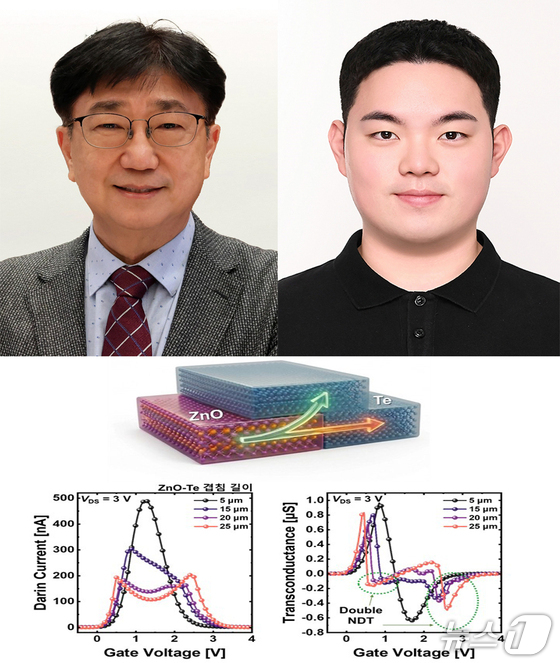
Researchers at POSTECH said on May 19 that a team led by Professor Lee Byung-hoon from the Department of Electrical Engineering and the Department of Semiconductor Engineering has developed a next-generation transistor technology capable of carrying out multiple circuit functions with a single semiconductor device.
The research team conducted the study to enable more functions to be implemented efficiently within limited chip space in the era of ultra-compact AI devices and highly integrated semiconductor systems.
The newly developed technology can perform frequency conversion functions that previously required multiple transistors using just a single device, significantly reducing circuit complexity while increasing data processing speeds by roughly four times.
The team created a heterojunction transistor with a new structure by combining zinc oxide (ZnO), which supports low-temperature processing, with tellurium (Te). The technology enabled complex semiconductor circuit functions to be implemented at the level of a single device.
Professor Lee said the technology is expected to improve both performance and power efficiency in ultra-compact AI electronics such as smartwatches and wearable devices, while also contributing to the development of next-generation 3D semiconductor integration technologies.