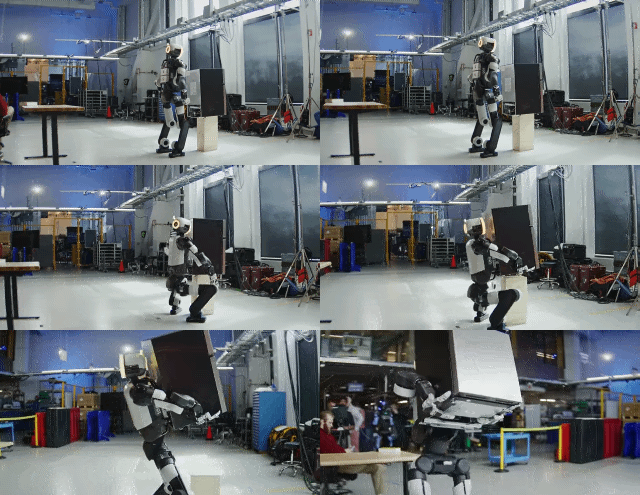
[Screenshot from the Boston Dynamics YouTube channel. / Courtesy of YouTube] Hyundai Motor Group subsidiary Boston Dynamics has released a new video showing its humanoid robot Atlas transporting an entire refrigerator, signaling that preparations for deployment at Hyundai production sites are effectively complete. The video demonstrates not only Atlas’ full-body control capabilities required for real-world industrial tasks, but also its ability to manipulate external objects in dynamic environments. According to Hyundai Motor Group on Monday, Atlas is seen bending its knees halfway before lifting a compact refrigerator weighing about 50 pounds using both arms. While carrying the appliance, the robot maintains balance as it walks toward a table positioned behind it. Atlas then rotates its upper body 180 degrees before carefully placing the refrigerator onto the table.
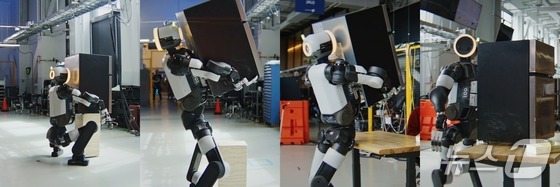
[Boston Dynamics released footage on its YouTube channel showing the humanoid robot Atlas transporting a refrigerator. / Courtesy of Hyundai Motor Group] Boston Dynamics said the video highlights advances in reinforcement learning and full-body control technologies. The company described the demonstration as a milestone showing Atlas moving beyond laboratory research and into practical industrial environments with unpredictable variables. To perform such movements, the robot must maintain stable posture even while carrying objects with varying sizes and weights. This requires sophisticated full-body control systems capable of adapting to changing physical conditions. The robot also needs to estimate uncertainty in real time using sensor-based state analysis, even when information such as an object’s mass or center of gravity is not fully known in advance.
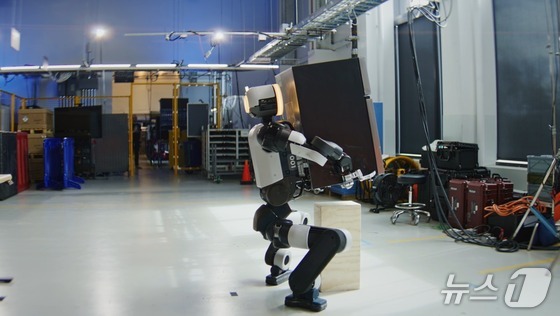
[Boston Dynamics released footage on its YouTube channel showing the humanoid robot Atlas transporting a refrigerator. / Courtesy of Hyundai Motor Group] According to Boston Dynamics, Atlas learned the movements through large-scale simulation-based reinforcement learning and successfully transferred those skills into real-world environments within weeks. The reinforcement learning process involved repeated cycles of success and failure in virtual environments to optimize movements for real industrial settings. Through this training, Atlas was able to transport not only a 50 pounds refrigerator but also larger models weighing up to 100 pounds, the company said. Because Atlas is being developed with commercialization in mind, the robot is designed for higher performance and easier compatibility. For example, its actuators have been standardized into two types, while both arms and legs share identical structures to simplify maintenance and component replacement.
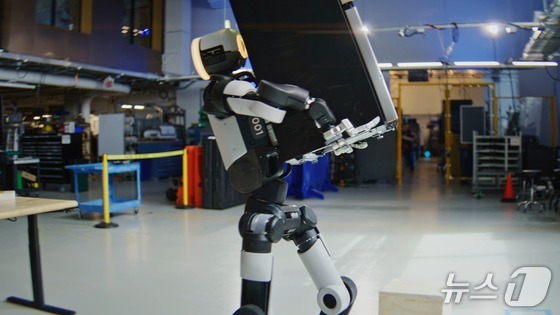
[Boston Dynamics released footage on its YouTube channel showing the humanoid robot Atlas transporting a refrigerator. / Courtesy of Hyundai Motor Group] Boston Dynamics also released a behind-the-scenes video showing how the Atlas prototype trained for the refrigerator-carrying task. The footage includes Atlas balancing on one foot while rotating 360 degrees and performing backflips. These movements require advanced control systems capable of independently coordinating the upper and lower body while minimizing interference between joints and maintaining smooth motion continuity. Boston Dynamics said movements such as handstands and backflips are important for evaluating Atlas’ flexibility and balance, as well as helping the robot learn recovery techniques after slipping or falling. Euisun Chung, executive chair of Hyundai Motor Group, said in an interview with Semaphore last month that the company plans to deploy Atlas robots at manufacturing facilities by 2028 and produce up to 30,000 units annually by 2030. Chung added that as customer demands become more sophisticated, robots and AI will become critical tools for improving both quality and productivity. He said the company aims to strengthen its global leadership by integrating research and development, software, design, and manufacturing capabilities.