Hyundai Glovis is gearing up for the future of autonomous shipping by testing remote navigation technology for its Pure Car and Truck Carriers (PCTCs). The company aims to upgrade its current autonomous navigation assistance technology to remote operation capabilities, positioning itself for the era of unmanned and fully autonomous vessels.
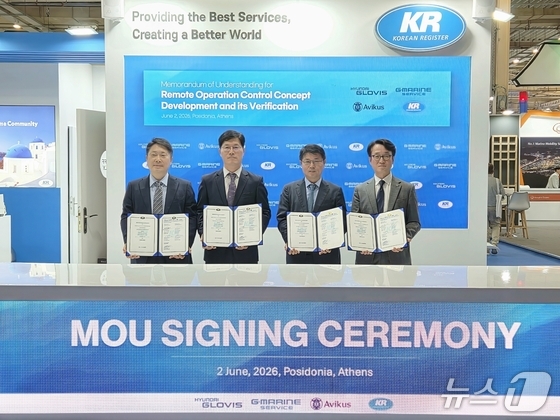
On June 2, Hyundai Glovis announced the signing of a four-party memorandum of understanding (MOU) at the Posidonia 2026 international maritime exhibition in Athens, Greece. The agreement, focused on developing and verifying remote navigation control concepts for PCTCs, involves Hyundai Glovis, its ship management subsidiary G-Marine Service, HD Hyundai’s autonomous navigation solution subsidiary Avikus, and the Korean Register.
The MOU is designed to test the viability of remote navigation technology and operational systems on Hyundai Glovis’s PCTCs.
During the demonstration phase, the four companies will collaborate to validate the feasibility of remote navigation technology and its operational framework. Hyundai Glovis will contribute its operational expertise and navigation data, while Avikus will provide autonomous navigation solutions and conduct technology verification. G-Marine Service will assist in reviewing operational procedures and emergency response protocols, and the Korean Register will oversee safety assessments and technical evaluations.
Hyundai Glovis currently operates eight PCTCs equipped with Avikus’s HiNAS Control, an autonomous navigation solution. This implementation follows a supply agreement between the two companies signed in July of last year.
The agreement covers the provision of HiNAS Control hardware and software, onboard installation, and crew training. Preliminary tests have shown promising results, with fuel savings of up to 3.9% observed during demonstration operations using HiNAS Control.
HiNAS Control is a cutting-edge autonomous navigation system that leverages artificial intelligence (AI) to analyze data from onboard navigation equipment and sensors. It offers optimal route suggestions, collision avoidance capabilities, and speed control. Hyundai Glovis plans to expand the use of this technology to its future fleet additions.
The evolution of autonomous shipping technology is progressing through several stages: Level 1 supports crew decision-making, Level 2 enables remote control with onboard crew, Level 3 involves unmanned remote navigation, and Level 4 represents full autonomy. Through this demonstration, Hyundai Glovis aims to validate the technology and operational systems required for the remote navigation phase.
The company’s objectives for this demonstration include verifying the applicability of Level 2 remote navigation technology and defining the technological and operational requirements for establishing a future Remote Operation Center (ROC). The ROC will serve as an integrated operating system, enabling real-time monitoring of ship status from land and providing navigation support and control.
A Hyundai Glovis spokesperson emphasized the significance of this demonstration, stating that this is a crucial step in advancing the autonomous navigation assistance technology to remote operation capabilities. They added that by accumulating operational experience based on real-world navigation data, it will systematically develop the technology and operational frameworks necessary for the era of fully autonomous navigation.