

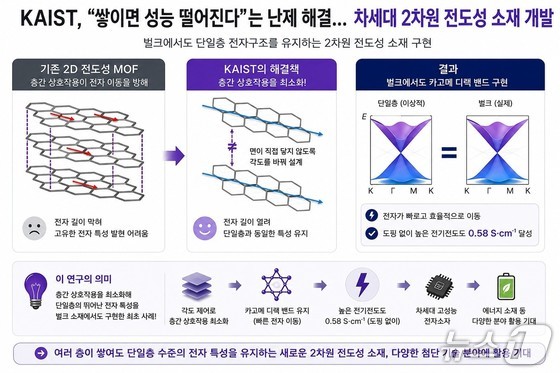
On Monday, the Korea Advanced Institute of Science and Technology (KAIST) announced a breakthrough in materials science. A research team led by Professor Park Sun-Ah from KAIST’s Department of Chemistry, in collaboration with Professor Christopher Hendon from the University of Oregon, has developed a novel two-dimensional conductive metal-organic framework (MOF). This innovative material maintains high electrical conductivity while minimizing interlayer interference, addressing a long-standing challenge in the field.
Two-dimensional (2D) materials, known for their atomic-level thinness, have long been considered prime candidates for next-generation semiconductors and quantum materials due to their ability to facilitate rapid electron movement. However, these materials have faced a significant hurdle: while they exhibit exceptional performance as single layers, their electronic properties tend to degrade when stacked in bulk form, limiting their practical applications.
To overcome this obstacle, the research team took an innovative approach, focusing on the angles between layers to prevent direct interference. Their newly designed molecular structure ensures that even when multiple layers are stacked, they maintain specific angles, minimizing direct contact between layers.
This clever design can be likened to stacking playing cards with a slight twist, preventing them from adhering to each other. The result is a significant reduction in interlayer interactions, allowing electrons to move more freely. To achieve this structure, the team engineered a triptycene-based molecule, which they used to synthesize the new two-dimensional conductive metal-organic framework (MOF) material.
The team’s groundbreaking material, dubbed Ni3(HITrip)2, demonstrates a remarkable ability to maintain an electronic structure similar to that of a single layer, even when in a multi-layered state. Crucially, it preserves a unique electronic configuration that enables quick and efficient electron movement.
Through rigorous calculations and spectroscopic analysis, the researchers also uncovered the mechanisms behind the material’s excellent conductivity. They found that within the material, molecules and metallic atoms work in tandem to facilitate electron movement, creating an environment conducive to stable electron flow. This discovery sheds light on the principles underlying the material’s high electrical conductivity.
The significance of this study lies in its successful address of a long-standing challenge in the field of two-dimensional materials: the tendency for performance to degrade when layers are stacked.
The researchers anticipate that their findings will have far-reaching implications, potentially revolutionizing the development of high-performance electronic devices and next-generation energy materials. Furthermore, they believe this breakthrough opens new avenues for research in quantum materials and topological substances, potentially accelerating advancements in future semiconductor and quantum information technologies.
Professor Park emphasized the groundbreaking nature of their work, stating that the research demonstrates that the two-dimensional electronic structure, previously thought to be achievable only in monolayers, can be realized in bulk materials. By precisely controlling interlayer interactions, we’ve opened new possibilities for implementing various quantum properties and electronic characteristics in practical materials.
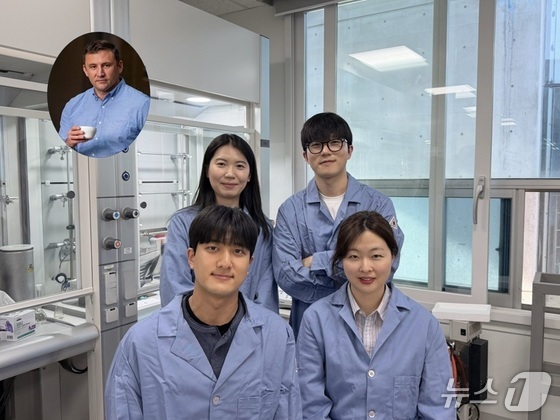
Looking ahead, the research team plans to explore potential applications for their conductive porous materials in sensors and energy storage systems. They aim to develop next-generation electronic devices and quantum material platforms by delaminating the material to single or few-layer levels.
This pioneering research, with KAIST Ph.D. candidate Park Geun-Chan as the lead author, has been published in the prestigious Journal of the American Chemical Society.
The study was supported by the National Research Foundation of Korea’s Basic Research Program and the National Supercomputing Center, underscoring the collaborative nature of cutting-edge scientific research.