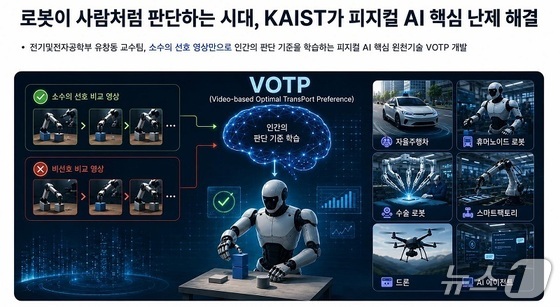
A groundbreaking technology developed by South Korean researchers now allows artificial intelligence (AI) to learn human judgment criteria without the need for manual evaluation of thousands of behavioral data points.
On Wednesday, the Korea Advanced Institute of Science and Technology (KAIST) announced that Professor Chang-dong Yoo’s research team from the Department of Electrical and Electronic Engineering has pioneered VOTP, a revolutionary technique enabling AI to grasp human intentions and judgment criteria using just a handful of preferred videos, rather than thousands of human-evaluated data points.
AI technology has been rapidly evolving, moving beyond text and image generation to enter the realm of physical AI, where machines can interact with and manipulate the real world.
However, a significant hurdle remains: teaching machines to develop human-like evaluation criteria to determine if their actions align with human intentions and which actions are most appropriate.
To tackle this challenge, researchers need a reward function that encapsulates human preferences and judgment criteria. The traditional approach of having people evaluate thousands of behavioral data points is both time-consuming and expensive.
Drawing inspiration from humans’ ability to learn new tasks after just a few demonstrations, the research team developed VOTP. This innovative technology enables AI to identify preferred behavioral patterns using only a small set of positive and negative examples.
This approach allows AI to internalize human judgment criteria and apply them across various scenarios without the need for extensive human-evaluated datasets.
The cornerstone of this research is the idea that intelligent machines, such as robots and self-driving cars, can swiftly comprehend human intentions through a limited number of videos showcasing human preferences. The team’s algorithm has proven its effectiveness and adaptability through comprehensive testing across diverse environments and tasks.
This method is poised to dramatically reduce the costs and resources required for human feedback and data compilation in physical AI development.
According to the research team, this technology has wide-ranging applications, from robotic arm control and humanoid robots to autonomous vehicles, smart factories, drones, surgical robots, and even AI agents that directly operate computers. It’s anticipated to serve as a foundational technology for all physical AI systems that need to learn and respond to human intentions and satisfaction levels.
Looking ahead, the team plans to partner with industry leaders to pilot the technology in manufacturing processes and service robotics, accelerating its path to commercialization.
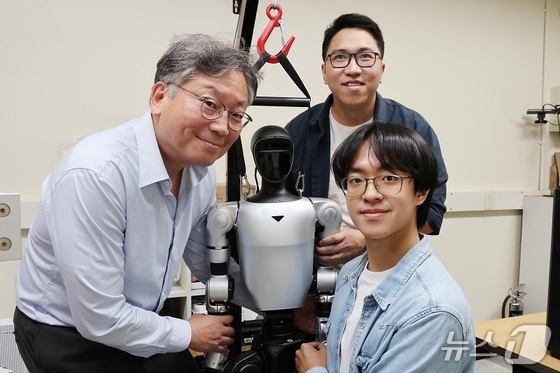
Professor Yoo emphasized that the essence of physical AI lies in enabling machines to understand human intentions and make appropriate decisions. VOTP’s ability to learn human judgment criteria from just a few video examples makes it a pivotal technology that will usher in an era where robots can make human-like judgments.
Ph.D. candidate Lu Min-tong from the Department of Electrical and Electronic Engineering, the lead author of the research paper, will present their findings at the prestigious International Conference on Machine Learning (ICML 2026) in Seoul this July. The paper’s selection for oral presentation, an honor reserved for the top 0.7% of submissions, underscores the significance of their work.
This groundbreaking research was made possible through funding from the Ministry of Science and Information and Communications Technology (ICT), with additional support from the Institute for Information & Communications Technology Planning & Evaluation (IITP) and the National Research Foundation of Korea (NRF).