

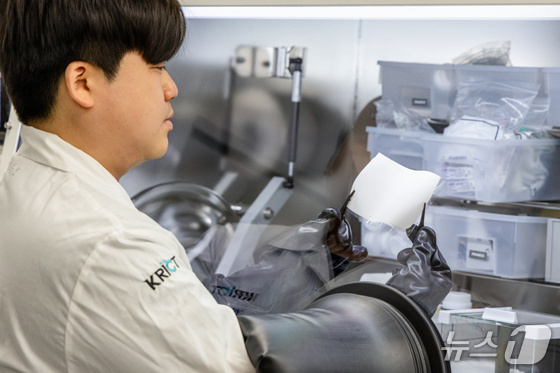
A team of South Korean researchers has developed an innovative technology that utilizes elastic ionic conductive materials to improve the longevity and stability of solid-state batteries.
On June 26, the Korea Research Institute of Chemical Technology announced a breakthrough by a collaborative research team. Led by Dr. Kim Dong-wook, along with Professor Hwang Seong-joo from Yonsei University and Professor Park Ho-seok from Sungkyunkwan University, the team has engineered a method to mitigate cracks and interfacial damage during charging and discharging cycles. This was achieved by incorporating elastic ionic conductive polymers into sulfide solid-state batteries, significantly enhancing battery lifespan.
Unlike their lithium-ion counterparts that use liquid electrolytes, solid-state batteries pose no fire risk, making them increasingly attractive as electric vehicles (EVs) gain popularity.
Sulfide materials, in particular, have caught the eye of global battery manufacturers due to their ability to facilitate rapid charging and high output comparable to liquid electrolytes.
However, the rigid structure of solid electrolytes and electrodes makes them susceptible to internal fractures with repeated use. These cracks impede electron and ion movement, drastically reducing battery life. As a result, high-pressure binding devices become necessary, adding to the battery’s weight and production costs.
Previous attempts to solve this issue by inserting rubber binders (NBR) or polyethylene oxide (PEO) layers between electrodes and sulfide electrolytes fell short due to decreased ionic conductivity and unwanted byproducts.
The research team’s novel approach involves infusing the sulfide electrolyte with elastic ionic conductive polymers. They inject a liquid precursor into the electrolyte, which then cures into a mesh structure, effectively filling the gaps between electrolyte particles.
This elastic polymer serves a dual purpose: it firmly binds the electrolyte and electrode while expanding the pathways for lithium ion movement.
In simulated charge-discharge tests, batteries incorporating the elastic polymer demonstrated remarkable stability, operating for over 2,500 hours. While conventional sulfide electrolytes suffered cumulative interfacial damage, the new technology maintained stable interfaces throughout.
The innovation also shines under rapid charging and discharging conditions, retaining significantly higher capacity. After 200 cycles, batteries with elastic polymers maintained 75% capacity, compared to just 22% for traditional sulfide electrolyte batteries – a more than threefold improvement.
Another notable advantage is the reduced dependency on external pressure. Conventional sulfide solid-state batteries require high operational pressure to maintain electrode-electrolyte contact.
In contrast, this new technology exhibits stable performance even under low-pressure conditions. The research team emphasizes that this could lead to substantial reductions in manufacturing costs and simpler battery structures, marking a significant step towards commercialization.
The potential applications for this technology are far-reaching, including next-generation sulfide solid-state battery manufacturing, advanced batteries for EVs, and high-safety energy storage systems. The team plans to conduct further tests on large-scale batteries and in EV environments.
Dr. Kim highlighted the significance of their work, stating that this technology addresses the fundamental mechanical stability challenges faced by sulfide solid-state batteries.
The groundbreaking research has been published in the prestigious international journal, Energy Storage Materials.