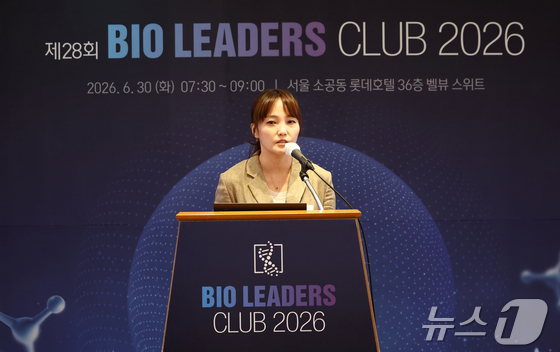
Companies with platform technology are best positioned for open innovation. Kim Joo-hee, Chief Executive Officer (CEO) of Inventage Lab, made this assertion while introducing the company’s drug delivery system (DDS) platform technology at the 28th Bio Leaders Club breakfast event. The gathering took place on Tuesday at the Lotte Hotel in Seoul’s Jung-gu district, organized by News1.
Inventage Lab currently boasts three platforms: DrugFluidic for long-acting injectables, GeneFluidic for gene delivery, and BioFluidic for subcutaneous formulations of antibody drugs.
Kim explained that even when new drug candidates are developed, they must be formulated optimally to work effectively in the human body. This fundamental technology is Inventage Lab’s specialty.
The company’s current flagship platform, BioFluidic, transforms liquid antibody drugs into high-concentration microparticles by removing moisture.
This technology enables us to create high-concentration particles of antibody drugs, making subcutaneous injections possible, Kim stated. The powder form allows for room-temperature distribution and self-administration via prefilled syringes.
Inventage Lab sets itself apart by developing not only platforms but also in-house production equipment and systems.
Kim emphasized that platform technology requires both research and stable mass production capabilities. It’s rare to find companies globally that develop both platforms and production systems.
The company is implementing continuous production methods and a modular production system. It aims to achieve annual production capacities of 1 million vials this year, 10 million next year, and 30 million by 2028.
Technology verification is also underway. The company has confirmed the platform’s applicability to various antibody drugs like Herceptin, Rituxan, and Keytruda, as well as antibody-drug conjugates (ADCs) and immunoglobulins. They’ve achieved high-concentration formulations of 400-500 mg/mL and are working towards 750 mg/mL.
Kim noted that Halozyme’s acquisitions of ElectroPharm and SurfBio, both with high-concentration subcutaneous formulation platforms, validated the direction and industry trends.
He highlighted collaborations with Daewoong Pharmaceutical, Chong Kun Dang, Yuhan Corporation, and Boehringer Ingelheim, adding that the most effective open innovation occurs when tech companies and pharma firms share responsibilities.
The 28th Bio Leaders Club event focused on Expanding Open Innovation: The Changing Pharma-Bio Investment Ecosystem Post-Drug Price Reform.
Attendees included lawmakers, government officials, industry leaders, and representatives from pharmaceutical, biotech, healthcare, securities, and venture capital firms, totaling over 50 participants.