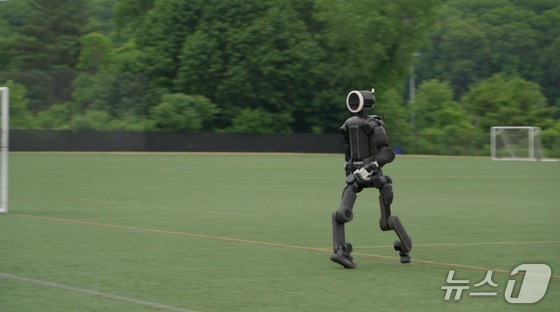
Boston Dynamics (BD), a Hyundai Motor Group subsidiary specializing in robotics, has unveiled the development process behind the humanoid robot Atlas’s halftime performance for the 2026 International Federation of Association Football (FIFA) World Cup.
According to Hyundai Motor Group on Thursday, BD released content on Wednesday detailing how they trained Atlas to navigate the unpredictable stadium environment.
On July 5, Atlas had already demonstrated its capabilities during the halftime show of a World Cup round of 16 match between Brazil and Norway, recreating goal celebrations of world-class soccer players and delivering the ball to the referee.
Atlas made a grand entrance from the players’ tunnel, electrifying the stadium atmosphere by performing celebrations of soccer icons such as Harry Kane, Erling Haaland, Matheus Cunha, and Son Heung-min.
Seth Davis, BD’s senior program manager, stressed that deploying a lab-developed robot in a stadium setting required considering multiple factors beyond the robot’s performance, including external communication, ground conditions, and human interactions.
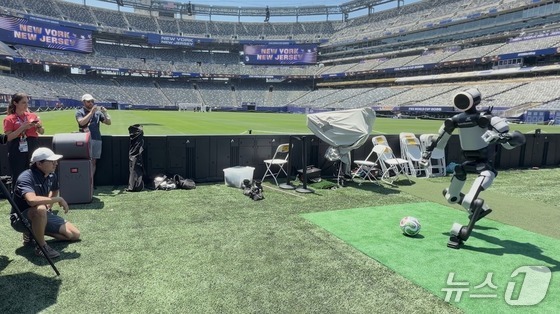
BD established a dedicated communication channel to overcome the limitations of Wi-Fi in a packed stadium. They also enhanced various systems and control functions to ensure reliable operation under intense sunlight and high outdoor temperatures.
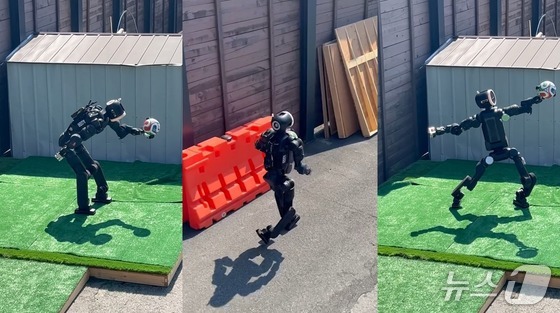
Adapting Atlas to grass presented a significant challenge. Unlike the smooth indoor floors Atlas was accustomed to, soccer field turf posed difficulties due to its inconsistent elasticity and friction, increasing the risk of stumbling or slipping.
To address this, BD incorporated modeling of foot-grass surface interactions into Atlas’s training. They even conducted tests on a local park’s soccer field to refine the robot’s performance on grass.
Achieving natural movements for goal celebrations and ball delivery to the referee demanded real-time responsiveness to environmental changes. BD focused on improving Atlas’s reaction speed and balance control.
They integrated reinforcement learning, human movement retargeting techniques, and whole-body control technology to create a cohesive system where all joints work in unison.
BD emphasized that this World Cup showcase was more than just a performance; it served as a validation process for robotic technology destined for future industrial applications.
They highlighted that the ability to execute precise, stable movements in a crowded stadium mirrors the skills required for successful operation in complex, dynamic factory environments.
A BD spokesperson stated that the ongoing goal is to develop Atlas beyond a robot capable of impressive movements, into an integral component of real-world manufacturing environments through continuous technological advancements.