

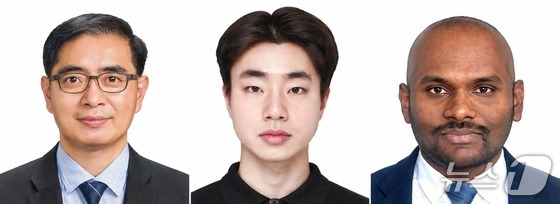
Kyung Hee University announced on Tuesday that Professor Min-cheol Seo and his research team from the Department of Information Display have developed a groundbreaking organic light-emitting diode (OLED) technology. This new tech minimizes color shifts when viewed at angles while significantly boosting light efficiency.
The team engineered an innovative structure that effectively extracts light typically trapped within OLEDs. Their cutting-edge findings were published in the prestigious international journal Advanced Science late September.
Front-emitting OLEDs, commonly used in smartphones, concentrate light to enhance screen brightness and color vibrancy. However, these displays have traditionally suffered from color distortion when viewed at angles and light loss due to internal trapping.
To tackle these issues, Seo’s team introduced a novel design featuring gentle curves within the OLED structure. This ingenious approach maintains consistent layer thickness while allowing for both focused light emission and the release of previously trapped light.
The results were impressive. Laboratory tests revealed a 25% increase in current efficiency, jumping from 302.7 cd/A to 378.4 cd/A. Even more striking was the near doubling of power efficiency, soaring from 199.3 lm/W to 396.7 lm/W.
Color consistency across viewing angles also saw marked improvement. The color shift index between direct viewing and a 60-degree angle plummeted by 56%, from 0.0197 to 0.0086.
Professor Seo emphasized the significance of their work, stating that its research charts a new course for OLED design, simultaneously enhancing front-view efficiency and viewing angle performance. It anticipates this breakthrough will pave the way for next-generation displays that are not only more energy-efficient but also offer consistent color reproduction across various viewing angles.