South Korea has recently joined Japan in the elite group of leading artificial intelligence (AI) nations, which includes the U.S., China, and the United Kingdom. While the country has garnered recognition for developing its own AI models and investing in infrastructure, experts point to the challenge of translating these achievements into industrial competitiveness as a key task for the future.
On Tuesday, the Boston Consulting Group (BCG) released its AI Maturity Matrix 2026 report, analyzing AI maturity across more than 75 global economies.
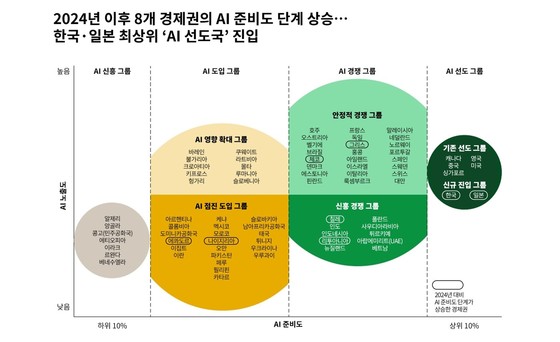
The report places South Korea in the top-tier AI Pioneers group alongside the U.S., China, the U.K., Singapore, Canada, and Japan. Since the initial survey in 2024, South Korea and Japan are the only new entrants to this prestigious category.
BCG commended South Korea for its strides in developing proprietary AI models and building computing infrastructure. The 2026 AI Index from Stanford University ranks South Korea among the top five globally in notable AI model development.
The evaluation was based on two key factors: AI exposure, which measures the potential impact of AI on industries and jobs, and AI readiness, which assesses the level of preparedness to utilize the technology. The readiness assessment analyzed six areas: national goals, talent, policies and regulations, investment, research and innovation, and ecosystem.
Eight economies, including South Korea and Japan, have advanced to a higher level of AI readiness compared to 2024.
BCG predicts that as countries increasingly establish AI strategies, the speed of applying technology to real-world industries will become the key determinant of competitiveness.
Jörg Hildebrandt, BCG’s Global Leader for the Public Sector, emphasized that government execution capability is crucial in transforming AI strategies into practical capabilities. He stressed the importance of securing top talent and expanding private investment.
The scope of AI applications is expected to broaden from finance and information technology to encompass manufacturing, logistics, and agriculture. BCG analysts believe that advancements in physical AI, such as humanoid robots and industrial automation, will drive these changes.
Hwang Hyung-jun, the head of BCG Korea, stated that South Korea’s entry into the group of AI-leading countries marks significant progress. He added that the crucial task now is to leverage this foundation to enhance tangible industrial competitiveness and business outcomes.
Hwang further emphasized that by integrating South Korea’s manufacturing prowess, industrial data, and operational expertise with AI, it can unlock new growth opportunities in industrial AI and physical AI.
In this report, BCG recommends that strengthening AI competitiveness will require global cooperation, expansion of computing and power infrastructure, cultivation of specialized talent, and stimulation of private investment.