

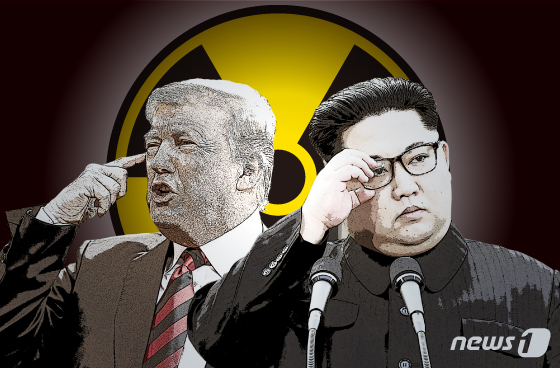
The White House announced on Monday that President Donald Trump remains open to dialogue with Kim Jong Un, the General Secretary of North Korea’s Workers’ Party, to achieve the complete denuclearization of North Korea.
According to Reuters, a White House official stated that President Trump is still willing to engage in discussions with Kim to fully terminate North Korea’s nuclear program.
This statement came shortly after Kim Yo Jong, deputy director of the Workers’ Party, declared that any attempts to deny North Korea’s status as a nuclear power would be firmly rejected, emphasizing that the U.S. must acknowledge their position as a nuclear state.
Previously, President Trump had referred to North Korea as a nuclear power or nuclear state multiple times since his inauguration on January 20, diverging from the official stance of the U.S. government.
As speculation grew that Trump’s administration might be acknowledging North Korea’s nuclear reality and using it as a starting point for realistic arms control negotiations, including freezing or reducing nuclear arsenals, the White House and State Department moved to quell the controversy. They reasserted that the administration remains committed to the complete denuclearization of North Korea.
Under international law, the only recognized nuclear powers are the five countries that conducted nuclear tests before January 1, 1967, as stipulated by the Treaty on the Non-Proliferation of Nuclear Weapons (NPT): the United States, Russia, China, the United Kingdom, and France. North Korea, which joined the NPT but announced its withdrawal in 2003, cannot be recognized as a nuclear power.
The United Nations Security Council explicitly stated through Resolution 1718 that North Korea cannot possess nuclear power status under the NPT.