

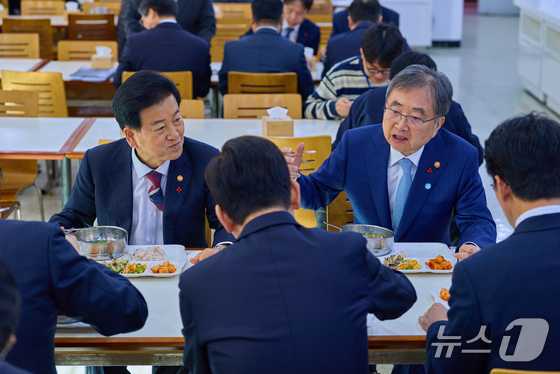
The Ministry of Unification has launched a communication channel with the U.S. Embassy in South Korea to discuss North Korean policies.
On Thursday, a ministry official told reporters that last week, the policy cooperation officer from the Ministry of Unification and the U.S. Embassy’s chargé d’affaires held an informal meeting. The official said they shared lunch to exchange assessments of the North Korean situation and discuss policies for peaceful coexistence on the Korean Peninsula.
Minister Jeong Dong-young had previously announced during a briefing following a presidential work report in December that the Ministry would conduct monthly consultations with the Ministry of Foreign Affairs and establish a communication channel at the policy director level with the U.S. Embassy.
On the same day, regarding the Defense Ministry’s proposal to the U.S. for joint management of the demilitarized zone (DMZ) jurisdiction, a Ministry official clarified that there had been no specific discussions with the Ministry of Unification.
The Defense Ministry reportedly proposed to the U.S. that the area north and south of the barbed wire fence, installed 1.24 miles south of the southern limit line in the DMZ currently under United Nations Command management, be divided. Under this proposal, the area north of the fence would remain under UN control, while South Korean forces would manage the southern portion. Initially, the fence was intended to follow the southern limit line. Still, due to terrain challenges and operational adjustments, it has been reported that in some sections, the fence is positioned north of the southern limit line.
It is understood that no practical discussions or information sharing occurred between the Ministry of Unification and the Defense Ministry during this process.
Previously, the ruling party, with support from the Ministry of Unification, pushed for legislation titled “The Law on the Peaceful Use of the DMZ.” This bill would grant the South Korean government authority to enter the DMZ for non-military and peaceful purposes. However, the United Nations Command has opposed this legislation, arguing that it conflicts with the armistice agreement.