

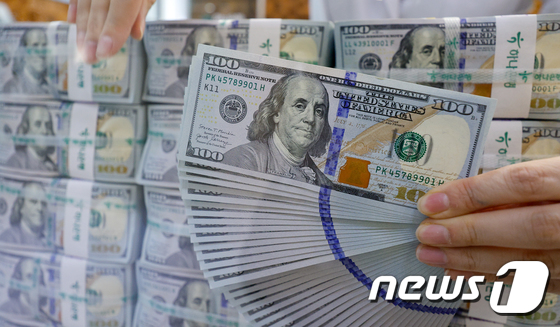
The USD-KRW exchange rate plummeted by over 20 KRW (about 0.014 USD), opening in the 1470 KRW (about 1 USD) range, following the announcement of a two-week ceasefire agreement between the U.S. and Iran.
According to the Seoul foreign exchange market on Wednesday, the dollar-won exchange rate opened at 1,479.9 KRW (about 1 USD), down 24.3 KRW (about 0.016 USD) from the previous close.
Min Kyoung-won, an economist at Woori Bank, forecasted that the USD-KRW exchange rate would decline today, citing renewed risk appetite sparked by Iran’s two-week ceasefire proposal and a weakening dollar.
Won added that the decline would be further amplified by aggressive selling from exporters re-entering the market around the mid-1500 KRW (about 1 USD) range, coupled with real demand and speculative positions from offshore long-stops that had been betting on exchange rate increases.
President Donald Trump announced via Truth Social that Iran had agreed to suspend attacks for two weeks, contingent on the full and immediate reopening of the Strait of Hormuz.
In response, Iranian Foreign Minister Abbas Araghchi confirmed Iran’s acceptance of the two-week ceasefire proposal, stating that Iranian forces would ensure safe passage through the Strait of Hormuz during this period. Reports indicate that Israel has also agreed to participate in the temporary ceasefire.
With the de facto agreement on a two-week ceasefire between the U.S. and Iran, attacks on Iran have ceased. The New York Times (NYT) reported, citing U.S. government officials, that military operations against Iran have been suspended in line with the ceasefire agreement.
In the wake of the Iran ceasefire, West Texas Intermediate (WTI) crude oil futures plunged by over 15%, trading around 96 USD per barrel. Brent crude futures also experienced a sharp decline of more than 11%, falling to approximately 93 USD per barrel.
The domestic stock market rallied on the ceasefire news, suggesting potential strengthening of the won, a risk-sensitive currency. The KOSPI index opened 5.64% higher at 5,804.7 points, triggering a trading halt due to a surge in buy orders early in the session.