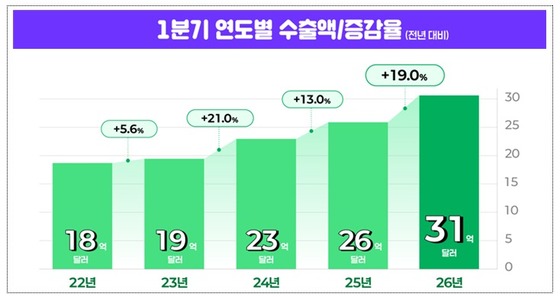
South Korea’s Ministry of Food and Drug Safety (MFDS) reported on Monday that South Korea’s cosmetics exports hit a record-breaking 3.1 billion USD (preliminary) in the first quarter of this year, marking a 19% increase from the same period last year.
While export figures for January and February remained relatively stable compared to the previous year, March saw a substantial 29.3% surge, with exports reaching 1.19 billion USD. This boost significantly contributed to the highest quarterly performance ever recorded.
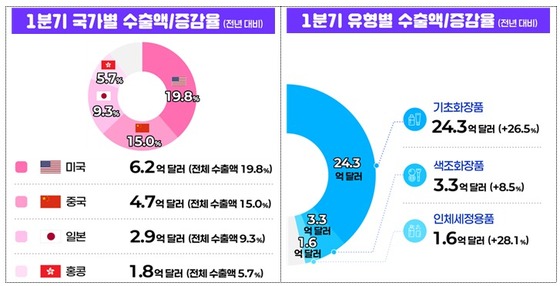
The U.S. emerged as the top export destination, accounting for 620 million USD or 19.8% of the total exports. China followed with 470 million USD (15%), and Japan with 290 million USD (9.3%).
The U.S. has maintained its position as South Korea’s primary cosmetics export market since claiming the top spot last year. Despite shifts in tariffs and trade conditions, the popularity of Korean cosmetics remains robust, fueled by the ongoing K-content phenomenon.
Breaking down exports by product category, skincare products led with 2.43 billion USD (+510 million USD, +26.5%), followed by color cosmetics at 330 million USD (+30 million USD, +8.5%), and personal cleansing products at 160 million USD (+30 million USD, +28.1%).
To capitalize on the global K-beauty trend and facilitate the expansion of Korean cosmetics in the international market, the MFDS is intensifying its regulatory diplomacy efforts with key countries.
This September, the agency plans to host the Global Cosmetics Regulatory Authorities Meeting (GICORAS), broadening the scope of the existing Asia-focused One Asia Beauty Forum to include the Middle East and South America. This initiative aims to spearhead global regulatory innovation for Korean cosmetics and reinforce strategic partnerships with major countries worldwide.
On April 8, the MFDS will establish a regulatory cooperation working group with Brazil’s National Health Surveillance Agency (ANVISA) to explore ongoing collaboration between the two agencies.
Following a recent cooperation meeting with China’s National Medical Products Administration (NMPA), the MFDS discussed streamlining the export process for domestic cosmetics. This ongoing collaboration aims to ensure that South Korean companies can enter the Chinese market seamlessly.
The MFDS emphasized its commitment to providing practical regulatory support for the cosmetics industry’s global expansion through the Cosmetics Global Regulatory Harmonization Support Center. This support includes online education on country-specific regulations, information on domestic and international licensing, global cosmetic ingredient regulations, real-time regulatory consultations, and updates related to the International Cooperation on Cosmetics Regulation (ICCR).