

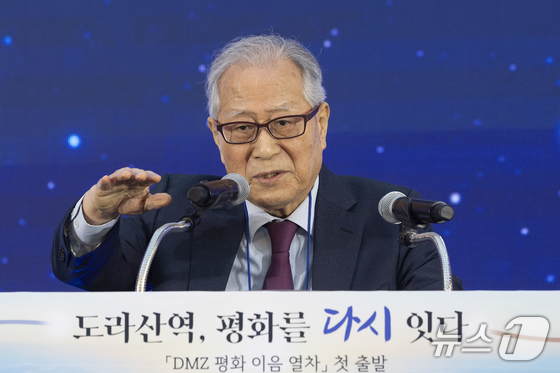
Former Unification Minister Jeong Se-hyun recently criticized the government’s decision to co-sponsor the United Nations (UN) resolution on North Korean human rights. On April 10, he stated that this won’t improve the human rights situation in North Korea. He argued that this move contradicts President Lee Jae Myung’s North Korea policy, which aims to respect the regime.
Jeong made these remarks at the Demilitarized Zone (DMZ) Peace Train Resumption Ceremony held at Dorasan Station in Paju, Gyeonggi Province. He emphasized that if President Lee says that it recognizes the North Korean regime, it don’t seek forced unification, and it won’t engage in hostile actions, then his staff should reflect that in policy. He added that why raise human rights issues with North Korea? The North Korea policy shouldn’t be inconsistent.
He further argued that to improve human rights in North Korea, the country’s economy must first develop, similar to China or Vietnam, questioning the effectiveness of participating in the human rights resolution.
Notably, he remarked that when the president speaks, his staff shouldn’t contradict him. The Secretary of State and National Security Advisor should avoid mentioning human rights issues. He even urged Unification Minister Chung Dong-young, who attended the ceremony, to provide training at the National Security Council (NSC).
Regarding U.S.-South Korea joint military exercises, Jeong stated that while it sees them as routine and defensive, North Korea views them as hostile. He expressed concern, saying that he’s read about another planned naval exercise between South Korea and the U.S., he sincerely hopes it doesn’t happen.
He noted that many North Koreans say, Even if it doesn’t work out, please keep sending the same message. He believes that if the president and his staff maintain a consistent approach, inter-Korean relations can stabilize, potentially transforming the hostile two nations into peaceful two nations.
Jeong also stressed that if the U.S. seems unlikely to support the government’s Korean Peninsula policy, the president should directly persuade them. He asserted that if the government insists on something, the U.S. will eventually agree. He reiterated the importance of an independent North Korea policy.
As an advocate for prioritizing inter-Korean relations, Jeong has frequently criticized the Alliance Faction, which favors addressing the North Korean nuclear issue through the U.S.-South Korea alliance and multilateral diplomacy. Last year, he openly criticized the State Department, stating that they’ve become accustomed to never defying U.S. demands, and accused National Security Advisor Wi Sung-lac of brazenly distorting facts.
The government had initially considered not co-sponsoring the North Korean human rights resolution, which the UN Human Rights Council has adopted for 24 consecutive years, but ultimately decided to join at the last minute.