

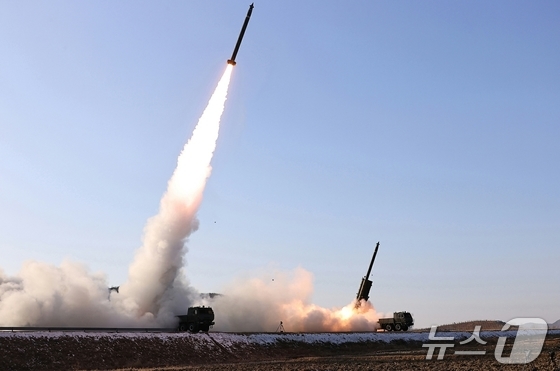
North Korea has recently escalated its military provocations, repeatedly launching ballistic and cruise missiles. Analysts suggest these actions are not merely saber-rattling aimed at the international community, but rather a series of quality control tests to evaluate the performance of new weapon systems. This indicates that North Korea is ramping up its efforts to modernize its arsenal.
On April 19, North Korea fired a ballistic missile into the East Sea from the vicinity of its submarine base in Sinpo. This latest provocation follows a string of recent launches, including an unidentified projectile near Pyongyang on April 7, a short-range ballistic missile (SRBM) from the Wonsan area on April 8, and cruise and anti-ship missiles fired from the new destroyer Choe Hyon on April 12.
North Korea has conducted several military demonstrations this year, including hypersonic and ballistic missile launches on January 4, tests of upgraded large-caliber multiple rocket launchers on January 27, and the firing of 600mm super-large rocket artillery on March 14. Notably, the regime has carried out four provocations in April alone, indicating an acceleration in the frequency of these tests.
North Korea has been particularly active in testing various weapon systems this year. The cruise missile launched on April 12 is of significant concern to both the U.S. and South Korea. While Pyongyang claims it can equip the cruise missile with a nuclear warhead, U.S. and South Korean assessments of this capability are ongoing.
The international community, including the U.S. and South Korea, currently does not consider North Korea’s cruise missiles a sanctions-worthy threat due to the low likelihood of nuclear warhead integration. This situation may be incentivizing North Korea to accelerate its cruise missile development program. Some experts suggest that the regime’s diverse new weapons development efforts are partly aimed at circumventing existing sanctions.
During a series of weapon system tests conducted from April 6 to 8, North Korea experimented with the short-range ballistic missile Hwasong-11A (KN-23) equipped with cluster munitions. These munitions, which North Korea refers to as dispersion warheads, contain dozens or hundreds of smaller submunitions in a single warhead. Upon detonation, these submunitions scatter over a wide area, potentially causing significant casualties and damage to infrastructure. This marks North Korea’s first use of cluster munitions in military provocations since 2022.
North Korea also claims to have tested electromagnetic weapon systems and carbon fiber munitions. The carbon fiber munitions, known as electromagnetic pulse (EMP) bombs, utilize graphite. When detonated in the air, these weapons release nickel and carbon fibers that attach to power lines or transformers, potentially causing widespread damage to electrical systems. This represents another new addition to North Korea’s expanding arsenal.
Kim Jeong-sik, the First Deputy Minister of the Party’s Military Industry Department, who oversaw the related tests, stated that electromagnetic weapons and carbon fiber munitions are strategic assets that can be integrated with various military systems across different operational environments.
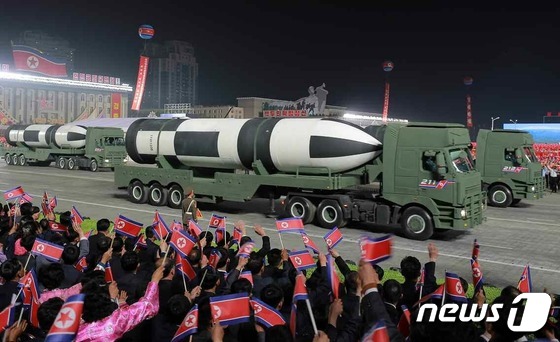
Kim Jong Un: Show of Force Equals Deterrence… Watching for Continued Provocations with New Weapons Systems
The recent surge in provocations from North Korea is directly linked to Kim Jong Un’s directive during the 9th Party Congress held in February, where he called for frequent demonstrations of the regime’s weapon development capabilities.
During that meeting, Kim stressed the importance of continuously testing the reliability and effectiveness of nuclear deterrent components and showcasing their power as a responsible exercise of war deterrence. This rhetoric suggests that North Korea now considers military provocations as part of its regular military activities.
Given that the Supreme Leader’s directives are typically subject to unconditional enforcement, experts anticipate that North Korea will likely continue to carry out various provocations using different weapon systems for the foreseeable future. They predict that during this process, North Korea will focus on performance verification and operational capability assessments, particularly for new weapon systems nearing deployment, through a series of test firings.
Professor Lim Eom-chul from Kyungnam University’s Far East Institute states that North Korea is accelerating its timeline to complete its nuclear capabilities in line with the New Five-Year Defense Development Plan declared at the 9th Party Congress. This goes beyond simple weapon development and involves rapidly transforming its military structure towards normalizing nuclear operations and conducting modern warfare centered on artificial intelligence (AI) and electronic warfare. It can expect continuous testing to follow as part of this strategy.