

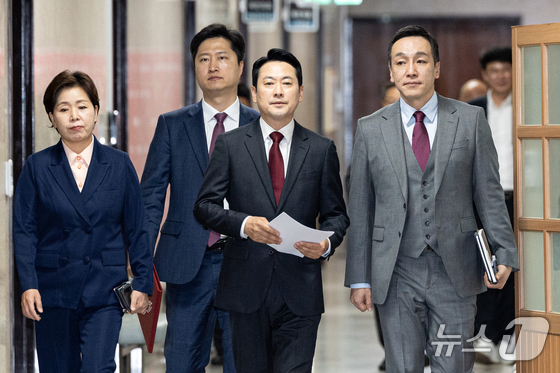
On Wednesday, Kim Dae-sik, the head of the U.S. delegation for the ruling People Power Party, addressed the recent controversy surrounding Representative Jang Dong-hyuk’s visit to the U.S. He stated that it attempted to meet with Vice President JD Vance and Secretary of State Marco Rubio, but our meeting didn’t materialize due to President Donald Trump’s extended meeting. However, we did meet with the third-ranking official from the National Security Council (NSC).
During his appearance on YTN Radio’s Jang Sung-cheol’s News Corner, Kim commented on Jang’s itinerary, saying that if the key points of the two-night, four-day trip had been clearly outlined, it could have had many positive aspects. However, he noted that the failure in managing a single photo and message overshadowed the overall results.
He expressed that he sincerely apologizes to the citizens and party members for presenting such an image, and emphasized that no matter how good a policy is, if the public rejects it, it’s invalid.
Nevertheless, Kim attributed significance to Jang’s visit itself. He argued that it’s not just about a local election when the leader of the main opposition party engages in diplomatic activities, and insisted that it needs to view it broadly in terms of the stability of the U.S.-South Korea alliance and national interests.
He continued that given that there’s a perception of instability regarding South Korea in the U.S., it’s meaningful for the leader of a conservative party to convey that there are no gaps in the U.S.-South Korea alliance. He added that when international circumstances stabilize, it ultimately benefits both local economies and South Korea as a whole.
Regarding criticisms of the visit’s outcomes, Kim highlighted meetings with prominent U.S. figures. He stated that he met with Representatives Young Kim, Adrian Smith, Ryan Zinke, Joe Wilson, and Bill Hagerty, noting that it’s significant for an opposition leader to meet these individuals during a brief two-night, four-day trip.
However, he explained that there were limitations regarding meetings with key White House and U.S. administration officials. He clarified that it met with an official from the White House NSC, but they requested anonymity, so it can’t disclose their name. He added that in diplomacy, there are aspects that can be made public and those that can’t.
Addressing reports of discord during the delegation’s internal schedule coordination, he remarked that some parts are accurate, while others aren’t. He acknowledged scheduling discrepancies and admitted to giving constructive criticism to Supreme Council member Kim Min-soo, but denied reports suggesting there was a quarrel.
On the controversy surrounding the visit’s costs, Kim mentioned that they’re currently finalizing the accounting, and stated that if necessary, it’ll make it public.
Regarding former leader Han Dong-hoon’s potential candidacy in the Busan Buk-gu by-election, he said that politics is about following one’s own path; no one can dictate who should or shouldn’t run. However, he cautioned against divisions within the conservative camp. He asserted that conservatives can’t win if they’re divided in Busan’s Buk-gu district, and emphasized that the priority is winning the election and uniting conservatives to regain the status as a governing party.
He added that since the Democratic Party is likely to nominate a candidate as well, this could create a competitive dynamic that enhances the appeal of both the People Power Party candidate and former leader Han, and noted that it doesn’t view the candidacy itself negatively.
Responding to Seoul mayoral candidate Oh Se-hoon’s criticism of Jang as the burden of candidates, Kim acknowledged the need for party reform. He stated that there are certainly aspects that don’t align with public expectations, and stressed that Jang must also adapt, and elections should focus on the candidates.
He emphasized that it needs to delegate campaign committee formation to metropolitan mayoral candidates like Oh Se-hoon and Park Hyung-jun, implementing responsible politics, adding that the central party should focus on managing policies and messaging.