

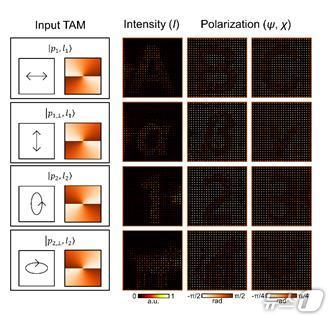
A revolutionary hologram technology has been developed that uses light movement as a key to reveal information only under specific conditions. This innovative approach is gaining attention for its potential to simultaneously overcome the limitations of existing optical communication and security technologies.
On Monday, the Korea Advanced Institute of Science and Technology (KAIST) announced that a research team led by Professor Shin Jong-hwa from the Department of Materials Science and Engineering has created a next-generation vector hologram metasurface. This breakthrough utilizes the total angular momentum of light as a crucial key for information selection, enabling the creation of different three-dimensional images based on the state of incoming light.
Metasurfaces, arrays of nanostructures smaller than the wavelength of light, are gaining prominence as next-generation optical components due to their ability to freely manipulate the properties of transmitted light. In modern optics, the polarization (SAM) of light and its orbital angular momentum (OAM), which spirals as it propagates, are considered essential physical quantities for encoding and controlling information.
However, independently controlling these two properties within a single device has long been an unsolved challenge in the field of optics.
To address this issue, the research team precisely engineered nanoscale structures much thinner than a human hair and stacked them in two layers to create a dual-layer metasurface.
This device employs the combined total angular momentum (TAM) of light’s polarization and degree of twisting, functioning like a complex encryption key. The device only responds when light vibrates in a specific manner and is twisted a certain number of times, thus revealing hidden information.
By applying this technology, even seemingly identical light beams cannot be read without the designated light key, ensuring high security.
Moreover, the twisting state of light (OAM) can theoretically have a vast range of values, significantly increasing the amount of information that can be carried by a single beam of light. This advancement could pave the way for ultra-high-capacity optical communication technologies capable of transmitting far more data simultaneously than current methods.
This research is particularly significant because it goes beyond merely creating three-dimensional images. It achieves a vector hologram by precisely controlling the polarization direction of light at each point in the image. Vector holograms represent a high-dimensional holographic technology that encompasses not only the intensity of light but also directional information.
The research team explained that this achievement is the first to demonstrate the independent control of two core properties of light (polarization and twisting) within a single device, which has traditionally been challenging to separate physically.
The technology is expected to find applications in next-generation display technologies such as immersive holograms, smart glasses, augmented reality (AR), and virtual reality (VR) devices. It also shows promise for developing secure labels that are difficult to replicate and ultra-fast optical communication systems.
Professor Shin stated that this research demonstrates the ability to combine the core properties of light—polarization and twisting—into a single independent information key for versatile use. It will evolve into a key platform for developing secure systems that are hard to replicate and for advancing ultra-fast, ultra-high-capacity optical communication technologies.
This groundbreaking research, with Dr. Jung Jun-kyu as the lead author, was published online in the prestigious international journal Advanced Materials.
The study received support from the Ministry of Science and Information and Communications Technology’s (ICT) Nano-Material Technology Development Project and Group Research Support Project, as well as the Ministry of Trade, Industry, and Energy’s Electronic Component Industry Technology Development Project.