

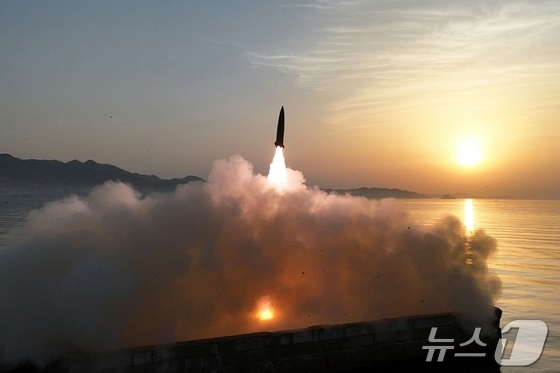
North Korea has shifted its weapons testing strategy this year, moving beyond simple performance evaluations to verifying real-world operational capabilities. Analysts on May 3 raised concerns that the potential combination of diverse warheads, including cluster munitions, with various delivery systems could significantly challenge U.S.-South Korea defense systems. Jo Jang-won, a visiting researcher at the Sejong Institute, assessed North Korea’s missile development trends from January to April in a recent report. He noted that these developments mirror weapon operational trends observed in recent U.S.-Iran military confrontations. Jo suggested that Pyongyang aims to demonstrate its ability to penetrate U.S.-South Korea missile defense networks and concentrate firepower on specific areas. This year, North Korea has conducted several provocative military tests, including: – A hypersonic missile launch on January 4 – Multiple firings of large-caliber rockets on January 27 and March 14 – Strategic cruise missile launches from the destroyer Choe Hyon on April 12 – Cluster munition tests on April 8 and April 19 North Korean state media claimed that during the April 8 test, the Hwasong-11 missile struck an area of 6.5 to 7 hectares. In the April 19 test, five Hwasong-11 missiles reportedly hit an island 136 kilometers away (about 85 miles), impacting an area of 12.5 to 13 hectares. Jo interpreted these actions as clear evidence that North Korea prioritizes maximizing real-world threats over adhering to international norms. Cluster munitions are highly controversial due to their wide area of effect and potential for civilian casualties. Most nations avoid openly acknowledging their possession of such weapons due to humanitarian concerns. Jo highlighted several key technical advancements North Korea appears to be pursuing: 1. Mixing hypersonic and short-range tactical missiles to enhance evasion capabilities 2. Mass-launching cluster munitions and large-caliber rockets to concentrate firepower 3. Diversifying warheads to neutralize South Korean and U.S. military infrastructure 4. Expanding cruise missile launch platforms from land to sea to improve survivability However, Jo noted that North Korea still faces significant technical challenges. Despite claims of successful hypersonic missile tests, the regime has not provided concrete evidence of the system’s effectiveness. Developing reliable hypersonic glide vehicles remains a complex task that even advanced nations like the U.S., China, and Russia have struggled with for decades. Other limitations in North Korea’s missile program include: – Unproven continuous firing capabilities for large-caliber rockets – Cluster munitions that are not necessarily new technology – Early-stage development of carbon fiber munitions – Lack of submarine launch platforms for strategic cruise missiles To counter these evolving threats, Jo emphasized the need for South Korea to enhance both its offensive and defensive missile capabilities. He recommended developing low-cost, high-efficiency interceptor systems and, in the long term, AI-driven real-time response systems capable of addressing multiple incoming threats simultaneously.