

The prolonged Middle Eastern conflict has increased instability in the global oil supply chain, but the government’s policy to diversify import sources is showing tangible results.
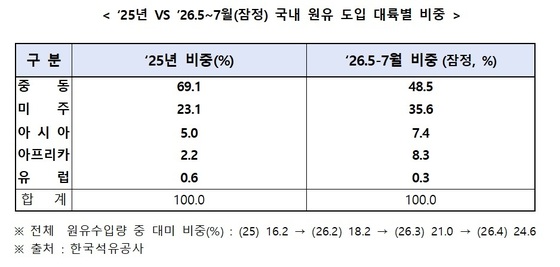
Following the outbreak of war between the U.S. and Iran, South Korea’s dependence on Middle Eastern oil dropped to 48.5% from May to July. This represents a decrease of about 20 percentage points compared to last year’s 69.1%.
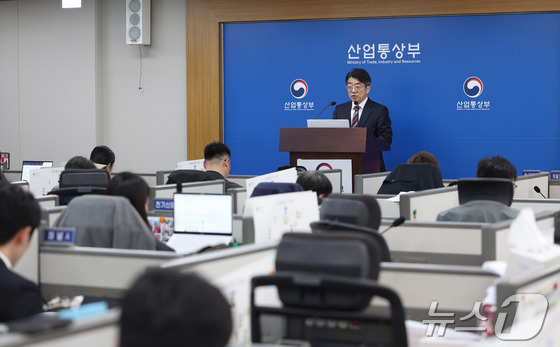
Yang Ki-wook, head of the Ministry of Trade, Industry and Energy’s Resource Security Division, stated during a briefing at the Middle East War Response Headquarters on Wednesday that the projected oil procurement volume for May to July is 220 million barrels, which is about 85% of the usual level, adding that the share of non-Middle Eastern oil has increased to nearly half due to diversification efforts.
According to the Ministry’s report on the continental share of domestic oil imports from May to July, the breakdown was as follows: Middle East 48.5%, Americas 35.6%, Asia 7.4%, Africa 8.3%, and Europe 0.3%.
The share of Middle Eastern oil, which accounted for 69.1% during the same period last year, has fallen sharply by 20 percentage points. In contrast, the share from the Americas has expanded to 35.6%, while oil is being sourced from various regions, including Africa (8.3%) and Asia (7.4%), indicating a diversification of the supply chain.
Notably, the increase in imports of American oil stands out. The proportion of American oil in total imports rose from 16.2% last year to 24.6% in April this year. As geopolitical risks in the Middle East have increased, American oil has significantly offset the reduction in Middle Eastern imports.
This shift is attributed to government support policies, such as the Strategic Oil Swap (SWAP) system and the expansion of refunds for oil import levies (freight cost compensation).
The Strategic Oil Swap system allows domestic refiners to borrow government-stored oil when purchasing crude oil abroad, with repayment occurring once the refiners secure their oil.
By utilizing this system, refiners can immediately receive the required quantities of oil even if they import crude from regions farther away than the Middle East, and they face fewer constraints related to oil types, such as heavy and light crude.
Yang explained that the swap application volume for April to May was 31 million barrels, with about 40% involving swaps between heavy and light crude oil.
The refund for oil import levies is a more direct support measure. The oil import levy refund system collects levies from refiners and oil importers when importing crude oil, and refunds them after they meet certain conditions.
When importing oil from non-Middle Eastern regions, the government previously refunded about 25% of the additional freight costs compared to Middle Eastern oil, but since mid-April, this has been expanded to a full refund.
Yang emphasized that from the perspective of the Ministry of Trade, Industry and Energy, budget expenditures such as freight support are necessary for resource security. It will continue to discuss this with the authorities, adding that while it hopes that the supply and demand instability from the Middle East will end soon, it will manage supply and prices to ensure there’s no cause for concern during this ongoing situation.
Meanwhile, the Ministry announced that it is still reviewing the method for releasing strategic oil reserves scheduled for next month on June 9.
Following the outbreak of the Middle Eastern conflict, the International Energy Agency (IEA) resolved to release 400 million barrels of strategic oil reserves globally to stabilize the market. Of this, South Korea has been allocated 5.6%, or 22.46 million barrels.
Yang stated that the method for releasing government strategic oil reserves is under review. According to the IEA, there are methods to indirectly increase market supply by releasing government reserves and reducing the mandatory release amounts for the private sector, explaining that currently, they’re considering both options. However, private refiners are showing a positive response to utilizing the swap system for the time being and don’t feel a pressing need for the release of strategic oil reserves.