

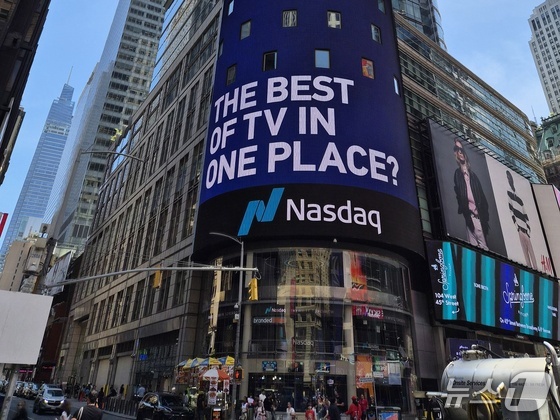
In the evolution of securities, physical certificates marked the first generation, electronic records the second, and tokenized assets now represent the third. Tokenization is ushering in the next era of finance. New York, long the global financial capital, is reinventing itself as the epicenter of tokenization.
The city has become a magnet for industry leaders: BlackRock, spearheading the tokenized treasury market; Franklin Templeton, pioneering tokenized money market funds (MMFs); OntoFinance, innovating in tokenized stock platforms; Securitize, revolutionizing digital securities issuance; and Flume Network, developing institutional real-world asset (RWA) solutions.
Wall Street is embracing asset tokenization as finance’s next frontier, fostering a dynamic ecosystem where traditional institutions and crypto innovators collaborate. Christopher Perkins, head of Franklin Crypto, told News1 in New York that Wall Street sees tokenization as inevitable. This perception is drawing startups eager to partner with financial giants to New York, organically building the ecosystem. Franklin Crypto, the digital asset arm of asset management behemoth Franklin Templeton, recently acquired 250 Digital to accelerate its tokenization initiatives. Industry experts attribute New York’s rise as the tokenization hub to Wall Street’s proactive engagement. As established firms bet on tokenization for future growth, they’re creating a virtuous cycle, attracting talent and startups alike.
Crypto Market Slumps, but Tokenization Triples
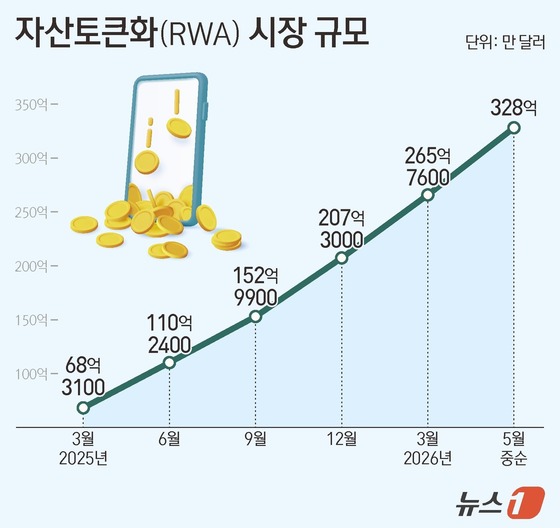
Wall Street’s tokenization focus is backed by impressive market growth. Data from rwa.xyz, a real-world asset tokenization platform, shows tokenized assets surged from 11 billion USD in June last year to 32.8 billion USD by mid-May this year – a threefold increase in just 12 months.
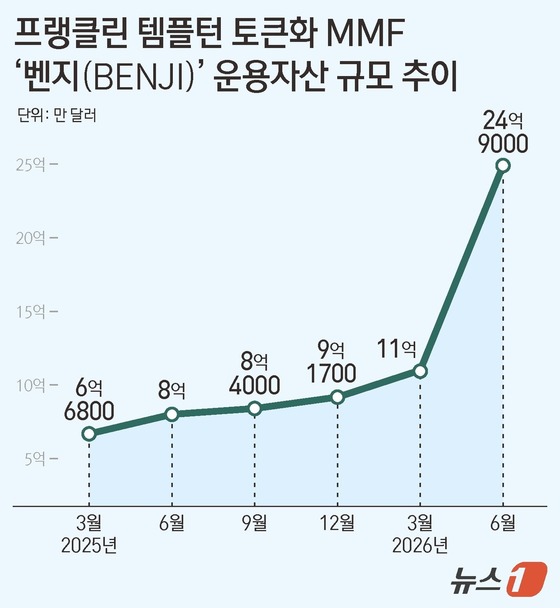
While the broader crypto market struggled with price corrections and reduced trading, tokenization continued its steady ascent. Perkins noted that four years ago, Wall Street viewed crypto as toxic. Now, they see not engaging with crypto as the bigger risk. It’s a complete 180 in institutional thinking. Giants like Franklin Templeton and BlackRock are leading the charge. Franklin Templeton launched BENJI, a tokenized MMF, while BlackRock introduced BUIDL, a tokenized treasury fund, both aimed at institutional investors. BENJI’s growth mirrors the wider trend, expanding from 800 million USD last June to 2.5 billion USD a year later – more than tripling in size.
Wall Street and Crypto: Allies, Not Adversaries
The tokenization market’s growth is driven by collaboration, not competition, between traditional finance and crypto firms. BlackRock’s tokenized offerings rely on Securitize for issuance and infrastructure. If Nasdaq moves into tokenized stocks, crypto exchange Kraken may serve as a distribution partner. Platforms like OntoFinance and Flume Network prioritize partnerships with established financial institutions. Teddy Pornprinya, Flume Network’s co-founder, explained that the proximity in New York facilitates strategy discussions and business development. As institutional tokenization grows, New York’s significance will only increase. The city has become a melting pot where Wall Street firms, blockchain startups, law practices, investment banks, and venture capital converge to advance tokenization. One insider remarked that just as Silicon Valley drove the internet revolution, New York is becoming the crucible of financial tokenization innovation.
Why Firms Flock to New York, Despite U.S. Customer Restrictions
Curiously, many leading tokenized products target non-U.S. customers. Robinhood offers tokenized stock trading to European investors, while OntoFinance primarily serves international clients. This is due to the evolving regulatory landscape for digital assets in the U.S. Yet companies remain in New York, anticipating imminent regulatory clarity. Congress is currently debating the Digital Asset Market Structure Act (CLARITY Act), which would define the legal status and oversight of tokenized assets. Nicola White, Robinhood’s crypto Vice President (VP), stated that once it has regulatory certainty, tokenized products for U.S. customers will proliferate. New York already has the talent and company ecosystem in place. The Securities and Exchange Commission (SEC) is also considering an Innovation Exemption to permit limited trading of tokenized stocks backed 1:1 by actual shares. White added that Robinhood prioritizes compliance, which is why they’ve focused on Europe’s clearer regulatory environment. The SEC’s openness to tokenized stocks is extremely promising. The industry views tokenization not just as a new product, but as a fundamental shift in financial infrastructure – akin to the transition from physical to electronic securities. Perkins concluded that tokenization is finance’s next chapter, and Wall Street is already preparing for this future.