

The recent peace accord between the U.S. and Iran has ignited optimism for a resurgence in South Korea’s used car exports, which had previously languished. With the Strait of Hormuz blockade set to be lifted, the Middle East—South Korea’s primary market for pre-owned vehicles—will reopen after a nearly four-month hiatus. However, industry experts caution that a return to normalcy may take up to six months, given the substantial backlog of Middle East-bound inventory and persistently high shipping costs.
Used Car Exports Down 28.7%; Middle East Accounts for One-Third of Overseas Shipments
Data released by the Korea International Trade Association (KITA) on Monday reveals that South Korea exported 211,487 used cars from January to April this year, marking a steep 28.7% decline compared to the same period last year. This downturn is largely attributed to the Strait of Hormuz blockade, which began on February 28 due to the U.S.-Iran conflict, effectively halting exports to the Middle East—a region that typically accounts for one-third of total used car shipments.
The impact on Middle Eastern exports was severe, with shipments plummeting from 14,294 units in January and February to a mere 4,508 units in March and April—a dramatic 68.5% decrease. The United Arab Emirates (UAE), South Korea’s largest market for used cars in the region, experienced an even more precipitous decline of 93.6% during this period.
As the U.S. and Iran move towards normalizing the Strait of Hormuz, the used car export industry anticipates a revival. Shipping through the Strait is expected to resume on June 19, coinciding with the signing of a peace memorandum of understanding (MOU) between the two nations. President Donald Trump took to social media to affirm that the Strait of Hormuz would be open for free passage, rejecting any tolls previously proposed by Iran during the conflict.
Kim Pil-soo, president of the Korea Used Car Export Association and a professor at Daelim University, told News1 that the Middle Eastern market, the primary outlet for used car exports, was blocked by the war but will now reopen following this peace agreement. It expects a significant upturn in used car exports after a challenging period. Park Young-hwa, president of the Korea Used Car Export Association, echoed this sentiment, stating that as used car export volumes rebound from the war’s impact, it anticipates substantial benefits for the industry.
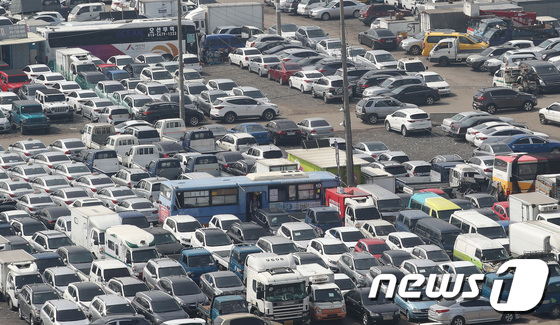
Despite the optimistic outlook, experts warn that it could take several months for exports to stabilize. The backlog of inventory destined for the Middle East has grown significantly over the past four months. An industry insider reported that used cars arriving at Incheon Port have overflowed into residential areas due to the sheer volume. Even with the resumption of shipping through the Strait of Hormuz, it will likely take about six months to clear the inventory and return to normal operations. Incheon Port, which handles 80% of South Korea’s used car exports, has been particularly affected by this bottleneck.
Soaring shipping costs present an additional challenge. According to industry sources, the Shanghai Containerized Freight Index (SCFI) reported that shipping rates for Middle East routes hit an all-time high of 4,816 USD per TEU (20-foot container) last week—nearly quadrupling pre-war levels.
A representative from the used car industry explained that given the relatively slim profit margins per vehicle, these exorbitant shipping costs may deter exporters from shipping altogether due to potential losses.
Even as exports to the Middle East normalize, a structural decline in overall used car exports this year seems inevitable. The four-month blockade has taken a heavy toll, compounded by the ongoing ban on used car imports from Russia implemented last year.
Professor Kim forecasts that even if exports to the Middle East return to normal by year’s end, it expects the total annual volume of used car exports to revert to around 600,000 units, similar to levels seen two years ago. For context, used car exports totaled 404,653 units in 2022, rose to 638,723 units in 2023, reached 627,875 units in 2024, before hitting a record high of 885,313 units last year.