

A recent study suggests that simply tallying correct answers is inadequate for assessing artificial intelligence (AI) mathematical prowess. The analysis reveals that AI models with identical scores may employ vastly different problem-solving approaches, depending on whether they stumble on questions that challenge humans or unexpectedly falter on problems humans find straightforward.
According to the information technology (IT) industry reports from Tuesday, researchers from Naver Cloud AI and the Korea Advanced Institute of Science & Technology (KAIST) AI have unveiled a paper titled KCSAT-ML, which evaluates AI reasoning models using math questions from South Korea’s college entrance exam and nationwide student error rates.
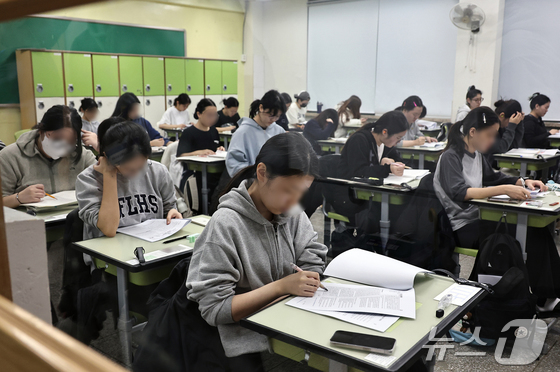
The research team compiled 664 math questions from college entrance exams spanning 2014 to 2025. They incorporated official error rates for 339 of these questions, reflecting how often actual test-takers missed each problem. This approach leverages statistics from exams taken by hundreds of thousands of students to inform AI assessment.
While previous mathematical evaluations primarily focused on AI accuracy and overall correctness, this study takes a novel approach. By attaching real student error rates to each question, researchers examined which specific problems tripped up AI systems.
Consider two AI models that both correctly answer 7 out of 10 questions. Their performance may not be equivalent. If one model errs on challenging problems that many humans also miss, while the other stumbles on questions most people find easy, it becomes difficult to consider their abilities equal.
To analyze this nuance, the researchers introduced a new metric called Difficulty-aligned Reasoning Gain (DRG). This measure assesses how closely an AI’s errors align with actual student error rates.
The analysis revealed that models with similar accuracy rates could exhibit markedly different DRG values. This indicates that seemingly comparable models may actually struggle with distinct types of problems.
Interestingly, the effectiveness of allowing AI more computational time before answering varied based on problem difficulty. For challenging questions that humans often missed, giving AI more time to think improved performance. However, for relatively simple problems, this extra processing sometimes led to overthinking and incorrect answers.
These findings underscore the need for AI performance evaluations to move beyond simplistic score comparisons. While AI models are often ranked based on their proficiency in math, coding, general knowledge, and language, identical scores can mask significant differences in real-world reliability, depending on the nature of the errors made.
This research also highlights the potential of South Korea’s standardized college entrance exam data. With its annual administration and accumulated statistics on test-taker performance for each question, this dataset could offer a more nuanced tool for evaluating AI’s mathematical problem-solving abilities.
As AI increasingly tackles complex decision-making tasks beyond basic calculations, industry experts argue that evaluation methods must evolve. This is particularly crucial in high-stakes fields like education, healthcare, and finance, where AI errors could have severe consequences. In these domains, understanding whether an AI struggles with genuinely difficult problems or makes unexpected errors on simpler tasks could be critical.
The research team concludes that accuracy alone is insufficient to differentiate between problem-solving approaches. They propose that standardized exam data with robust test-taker statistics, such as those from South Korea’s college entrance exam, could serve as a new benchmark for assessing AI reasoning capabilities.