

Reports suggest that the U.S. has incorporated a 300 billion USD plan for Iranian reconstruction investments into its ceasefire agreement with Iran. Concurrently, on Tuesday, discussions emerged about the potential easing of sanctions on Iran if the country takes steps to freeze its nuclear program.
If this proposal is accurate, it indicates that the Donald Trump administration has set economic compensation and sanction relief as conditions for Iran’s nuclear freeze. As negotiations with Iran conclude, analysts believe a similar approach could be applied to North Korea’s nuclear issue.
However, this strategy mirrors the negotiation tactics employed during Trump’s first term, which previously encountered setbacks. North Korea now asserts its nuclear power status more forcefully than before, making it unlikely that the Iran negotiation model would be applicable to North Korea.
The U.S. appears to have offered Iran economic incentives tied to a phased implementation of nuclear abandonment.
On Monday, President Trump addressed reporters in Évian-les-Bains, France, regarding the U.S.-Iran ceasefire Memorandum of Understanding (MOU). He emphasized that the most crucial aspect is ensuring Iran doesn’t possess nuclear weapons, adding that Iran has fully agreed to this under strict monitoring conditions.
Regarding sanctions relief, Trump stated that it ultimately depends on Iran’s actions. Once Iran fulfills its obligations, the easing of sanctions will commence. This suggests that the U.S. will relax sanctions in response to Iran’s specific actions following the official MOU signing.
On Monday, the Financial Times(FT) reported, citing a senior U.S. official, that the Trump administration proposed a substantial 300 billion USD fund for Iranian reconstruction alongside sanction relief. According to the FT, this fund would be established through private investments after meeting three conditions: a 60-day ceasefire extension, reopening the Strait of Hormuz, and further progress in nuclear negotiations.
The Trump administration plans to initially offer small financial benefits as a trust-building measure, gradually allowing access to larger funds. A senior U.S. official stated that the U.S. and Iran are in the early stages of building trust, adding that the U.S. is prepared to unfreeze funds and lift sanctions.
The core of the negotiations centers on Iran agreeing to dismantle its nuclear program and eliminate nuclear materials immediately, in exchange for U.S. investment, reconstruction support, and sanctions relief through a phased implementation process.
After Concluding Negotiations with Iran, Trump May Shift His Focus to North Korea… Dialogue Will be Challenging Due to North Korea’s Evolving Stance
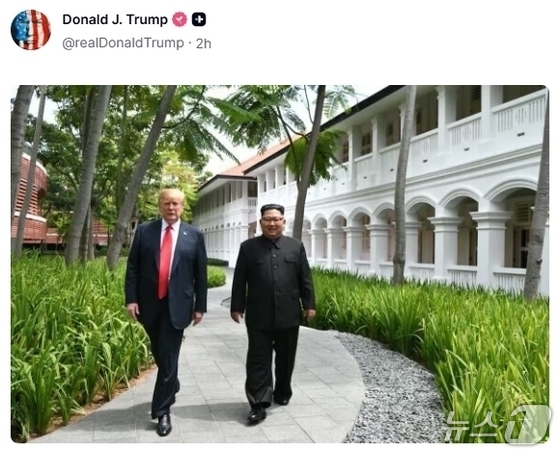
Experts believe that President Trump, who has consistently shown interest in negotiations with North Korea, may soon apply this transactional approach to the North Korean nuclear issue as well.
On June 13, President Trump posted a photo on his Truth Social platform, showing him walking alongside Kim Jong Un, the General Secretary of the Workers’ Party. The image, taken after their first summit on June 12, 2018, depicts the two leaders strolling in the Capella Hotel garden on Singapore’s Sentosa Island. While no explanation accompanied the post, some interpret it as Trump signaling North Korea as his next negotiation target, ahead of the Iran MOU signing on June 19.
If U.S.-North Korea dialogue resumes, the U.S. will likely address the North Korean nuclear issue in conjunction with easing sanctions, promoting economic development, and attracting investment. President Trump has consistently expressed interest in major North Korean tourist sites and real estate, including the Wonsan-Kalma Coastal Tourist Area.
However, it remains uncertain whether North Korea will respond positively if Trump proposes a negotiation strategy similar to past approaches. While North Korea keeps the door open for dialogue with the U.S., it maintains a firm stance that denuclearization cannot be part of the agenda.
Notably, after the 2019 Hanoi summit breakdown, North Korea shifted focus to reinforcing its position as a nuclear power. Internally, it has completed institutional adjustments to solidify this status through constitutional amendments.
During the February party congress, General Secretary Kim stated that if the U.S. respects our constitutional status as a nuclear power, there’s no reason it can’t have good relations. He made it clear that future negotiations would start from a different baseline than during Trump’s first term.
Recently, North Korea strongly reacted to mentions of denuclearization during the sixth U.S.-South Korea Nuclear Consultative Group (NCG) meeting and U.S.-Japan extended deterrence dialogue (EDD), declaring denuclearization an irreversibly concluded matter. China’s apparent acceptance of North Korea’s nuclear status during their summit has further bolstered North Korea’s confidence.
In this context, if President Trump aims to bring General Secretary Kim to the negotiating table, he will likely need to present a much stronger incentive than during his first term.
Professor Lim Eom-chul from Kyungnam University’s Institute for East Asian Studies noted that attempts to negotiate North Korea’s nuclear issues through sanctions relief and tourism cooperation were made during Trump’s first term. Given Kim’s heightened sense of pride now, unless the U.S. effectively recognizes North Korea’s nuclear power status or offers unprecedented sanctions relief, initiating U.S.-North Korea dialogue will be extremely challenging.