


As the U.S. tightens export controls on advanced artificial intelligence (AI) for cybersecurity, treating it as a strategic asset, Chinese AI firms are swiftly unveiling security-focused models to narrow the gap. While the U.S. adopts a closed strategy, Chinese companies are embracing open-source methods, intensifying the competition in cybersecurity AI.
Industry sources reported on Wednesday that Chinese AI company Zhipu AI recently unveiled GLM-5.2, its next-generation general-purpose AI model. GLM-5.2 excels in agent-based tasks such as planning, coding, and repetitive operations.
GLM-5.2’s standout feature is its vulnerability detection capability. According to reports from The Wall Street Journal and other international media, GLM-5.2 can identify software vulnerabilities at a level comparable to Anthropic’s Mithril.
In evaluations by cybersecurity firm Semgrep, GLM-5.2 outperformed Opus 4.8, one of Anthropic’s top AI models, in certain vulnerability detection categories. Researchers noted that with appropriate additional prompting, GLM-5.2’s vulnerability detection performance could rival that of Anthropic’s Mithril.
China’s 360 Security Technology also recently introduced Tulongfeng, an AI-powered vulnerability detection tool. The company’s founder, Zhou Hongyi, described Tulongfeng as comparable to Mithril in its capabilities.
As the cybersecurity race between the U.S. and China intensifies, their strategies are diverging. While the U.S. restricts access to its companies’ latest models, Chinese firms are rapidly expanding their user base and market presence.
GLM-5.2 is available as an open-weight model, allowing anyone to download, modify, and operate it. On the AI brokerage platform OpenRouter, GLM-5.2 ranks 7th, surpassing Claude Opus 4.8 (9th) and GPT-5.5 (12th). CNBC reports that GLM-5.2’s token traffic is growing faster than DeepSeek V4’s, generating buzz comparable to DeepSeek’s 2025 launch.
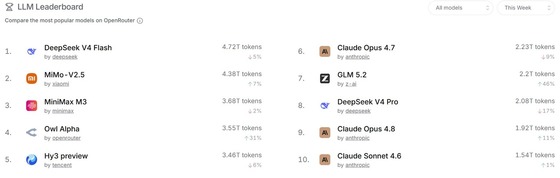
Analysts suggest that if U.S. restrictive policies continue, Chinese companies’ influence could grow rapidly. Elon Musk recently predicted on X that GLM-5.2 might catch up to Anthropic’s latest model by Q1 2027. However, Zhipu AI’s founder, Tang Jie, confidently commented that it won’t take that long.
With U.S. export controls tightening, the race for AI sovereignty among nations is intensifying. South Korea, aiming to challenge the global AI triad, is accelerating efforts to secure AI sovereignty. It’s developing independent AI foundation models and has begun work on a Physical AI General Foundation Model in preparation for the era of physical AI.
On June 28, Deputy Prime Minister and Minister of Science and Information and Communications Technology (ICT) Bae Kyung-hoon emphasized at the Korea’s Great Leap 3 Mega Projects National Report Meeting that accelerating physical AI requires localizing the entire AI stack, including robots, general-purpose physical AI models, world models, and network security.