

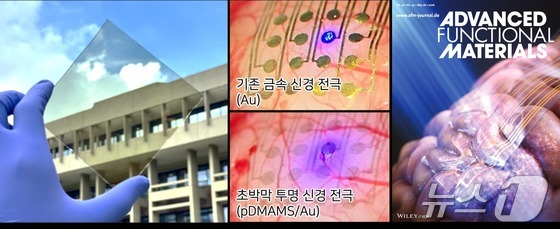
A team of Korean researchers has developed an ultra-thin transparent neural electrode that can read brain signals while allowing light to pass through. In experiments with blind mice, they achieved artificial visual signals that were 78% similar to normal visual responses.
The Korea Institute of Science and Technology (KIST) announced on Tuesday that a joint research team led by Drs. Sung Hye-jung and Lim Mae-soon from the Institute of Brain Science has developed this groundbreaking ultra-thin transparent neural electrode for use in artificial vision.
Retinitis pigmentosa, a disease affecting approximately 2 million people worldwide, causes vision loss due to damage to light-detecting cells in the eyes. While the eyes can’t detect light, the brain’s visual center, which interprets neural signals, remains relatively intact. This has led to the possibility that directly stimulating the brain could restore vision.
This breakthrough goes beyond simply replacing damaged retinas; it demonstrates the potential for artificial vision technology that creates visual signals by directly stimulating the brain’s visual center.
The key innovation lies in the technology that transmits light to the brain while simultaneously reading brain signals. Conventional metal electrodes excel at measuring electrical signals but block light. In contrast, transparent electrodes allow light to pass but suffer from reduced conductivity or noise during light stimulation that can mask brain signals.
The research team tackled this challenge with a special polymer coating. They applied this coating to the electrode surface before adding a metal layer, ensuring that gold atoms spread thinly and evenly without clumping. This innovation reduced the thickness of the gold film from 100 nanometers (nm) to just 10 nanometers.
The developed electrode has a total thickness of about 4 micrometers (µm), making it 15 times thinner than a human hair. Its ultra-thin and flexible design allows it to conform closely to the brain’s surface.
The electrode maintained its electrical signal measurement performance while allowing over 65% of light transmission. Electrical noise generated during light stimulation was reduced by up to 74%. The electrode also retained its performance after 20,000 cycles of bending and straightening.
In their experiments, the research team placed the electrode on the brain surface of blind mice and stimulated neurons using blue light-based optogenetics. The results were remarkable: they generated artificial visual neural signals that matched 78% of the brain signals from mice with normal vision.
KIST hailed this achievement as proof that stimulating the brain’s visual center with light can induce responses remarkably close to natural vision.
The implications of this technology extend beyond artificial vision, with potential applications in restoring hearing and touch. It also shows promise as a key component in brain-computer interfaces (BCI) that read brain signals and regulate stimulation.
This groundbreaking research was supported by the Ministry of Science and Information and Communication’s (ICT) Basic Research Program and KIST’s Unique Institutional Project. The findings were published as the cover article in the latest issue of the prestigious international journal Advanced Functional Materials.