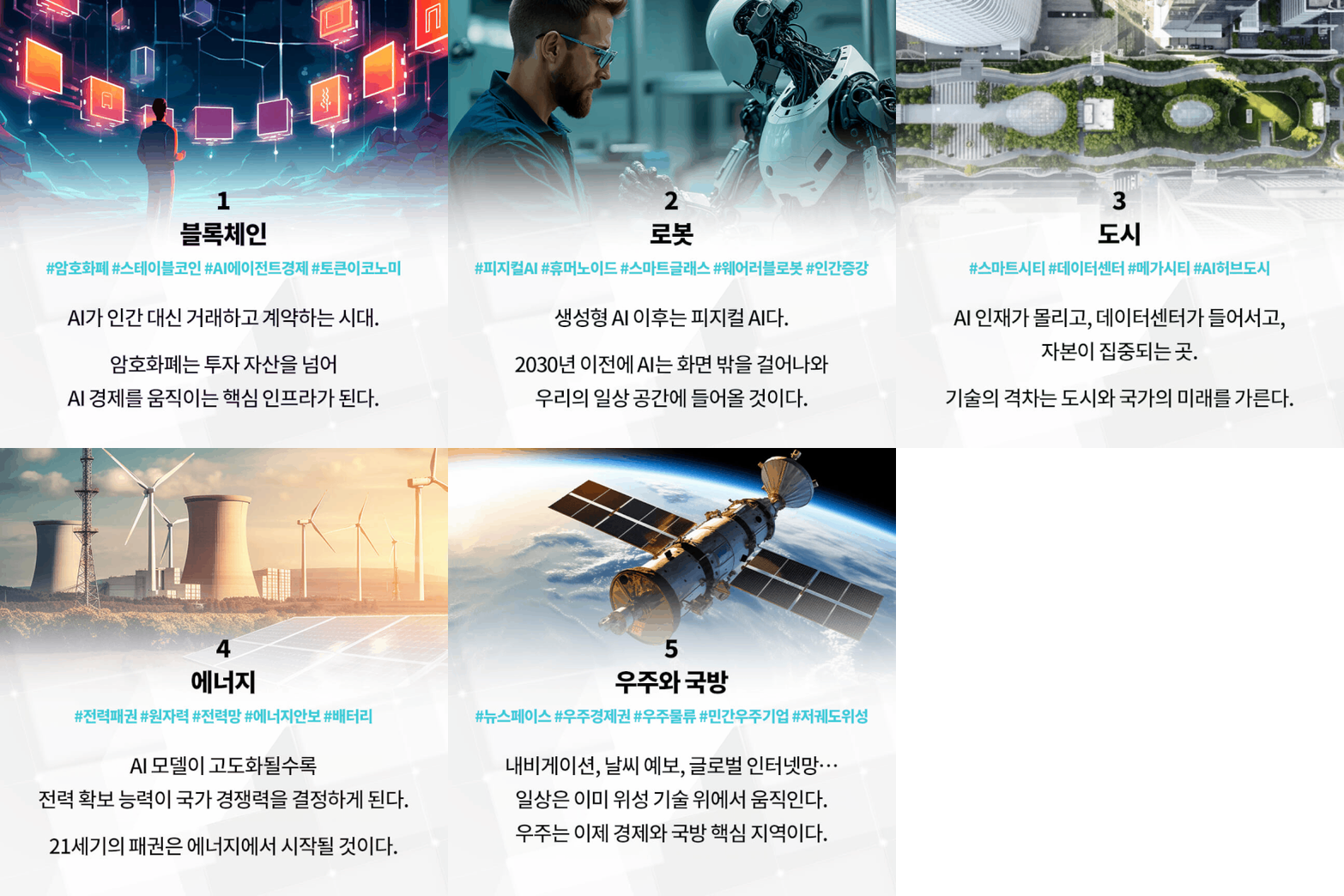
Park Jeong-ho’s Technology Forecast examines the next decade’s transformations through five key sectors: blockchain, robotics, cities, energy, and space. The author traces the movement of money and power where these technologies intersect, unveiling the structure of future industries.
While we often hear that artificial intelligence (AI) is revolutionizing everything, this book contends that AI alone doesn’t drive change. The premise is that real transformation occurs when computing infrastructure, power grids, payment systems, urban infrastructure, satellite communications, and logistics networks evolve in tandem.
How Converging Technologies Are Reshaping Capital Flows
The book posits that if the cryptocurrency market, Bitcoin included, merges with AI computing power, we’ll see radically different scenarios unfold (p. 43). The opening chapter explores blockchain not just as the future of finance, but as a cornerstone of the AI era’s transactional landscape. It notes how crypto market players, chasing economic incentives, gravitate towards times and places with affordable, clean energy – a trend that aligns with AI computing demands.
The text also delves into stablecoins, examining their dual role as dollar alternatives and complements. It explores efforts to anchor their stability to gold or Bitcoin, illustrating the ongoing restructuring of trust systems. Rather than focusing on individual tech performance races, the book emphasizes tracking emerging industries and capital flows by linking blockchain, robotics, smart cities, energy, and space.
Robotics’ Edge Lies in Augmentation, Not Replacement
The robotics section distinguishes between humanoid and wearable robots. It contrasts development approaches by companies like Tesla, Figure AI, and NVIDIA, concluding that real-world data is the crucial asset for all.
The forecasts are precise: between 2025 and 2027, wearable robots could see 30-40% annual growth in healthcare, manufacturing, logistics, agriculture, and construction. Humanoids, set for major deployment from 2027 to 2030, are likely to remain niche for some time.
Robots that enhance human capabilities will gain wider, faster acceptance than those aiming to replace humans (p. 148). Thus, the book predicts wearables will outpace flashy humanoids, arguing that human-augmenting machines will lead in technical feasibility, economic viability, and social acceptance.

Cities and Power: The Physical Foundations of AI
The urban chapter argues that the AI supremacy race ultimately boils down to city competitiveness and data center locations. Data centers are evolving from invisible backend facilities to major land consumers, reshaping urban planning and power grid expansion debates.
To meet AI and cloud demands by 2030, the book projects data center capacity must nearly double. It estimates an additional 2 billion square feet – equivalent to about 26,000 football fields – will be needed, with potential sites ranging from suburbs to former factories, farmland, and near-urban areas.
The energy chapter spotlights the race to secure power for the AI-driven civilization. It highlights small modular reactors (SMRs) as an attractive option for tech giants, offering consistent power for data centers with the flexibility to add capacity as needed.
The text cites Amazon’s direct purchase of 960 megawatts from a Pennsylvania nuclear plant and Google’s 500-megawatt SMR power deal as examples of this trend. It interprets these moves as tech companies securing the physical foundations for AI development.
Space: Charting The Next Industrial Frontier
The space chapter looks beyond rocket and satellite manufacturing to emerging markets. It presents the concept of low Earth orbit biofactories producing proteins, pharmaceuticals, and biomaterials as a strategy to gather data unattainable on Earth.
As reusable rockets slash costs, space is transforming from an exclusive domain to an industrial testbed. The book argues that space offers biotech firms a unique opportunity to gather groundbreaking data, broadening our view of the space industry’s potential.
It highlights the downstream sector as the fastest-growing market segment. Satellite navigation, internet services, and applications of space imagery and data are key areas, accounting for roughly 73% of the entire space industry in 2022.
Author Park Jeong-ho is an economist who analyzes this technological landscape through the lenses of industry, history, technology, and geopolitics. With a background in economics from Yonsei University, business studies from KAIST, and industrial design from Hongik University, Park currently serves as a professor at Myongji University and deputy director of the Korea Economic and Industrial Research Institute.
△ “Technology Projection” by Park Jeong-ho, 335 pages