

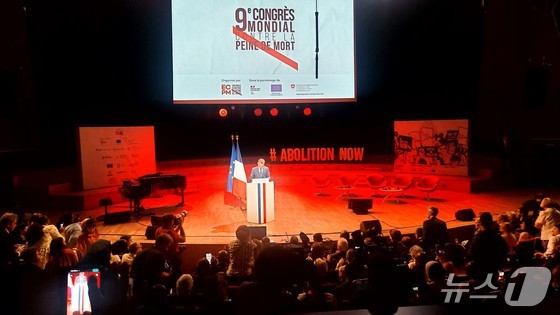
The Transitional Justice Working Group (TJWG), a human rights documentation organization, said on July 3 that it reported on the North Korean Kim Jong Un regime’s use of capital punishment at the 9th World Congress Against the Death Penalty, held in Paris, France from June 30 to July 2, and called for stronger international pressure on Pyongyang.
The global congress, organized by the World Coalition Against the Death Penalty (WCADP) and supported by the French government, the European Union, and the Swiss Ministry of Foreign Affairs, featured French President Emmanuel Macron, who expressed support for the global movement to abolish the death penalty.
At the event, criticism was raised over North Korea’s use of executions as a tool of political fear and social control. This was the first time North Korea’s execution practices were formally highlighted at the World Congress Against the Death Penalty.
During a plenary session on “the situation in East Asia,” North Korean human rights activist and defector Kim Eun-ju, author of The Eleven-Year-Old’s Will, testified about public executions and the lasting psychological trauma experienced by witnesses, prisoners’ families, and communities.
On the second day, a roundtable discussion listed North Korea alongside Iran and Saudi Arabia as key cases of concern regarding execution practices.
Shin Hee-seok, legal analyst at TJWG, said that executions in North Korea are often carried out without fair trials and through extrajudicial or arbitrary procedures. He argued that, based on international human rights standards, the 2014 UN Commission of Inquiry (COI) report on North Korea, and findings by UN working groups, these practices can be characterized as crimes against humanity.
As a side event to the congress, TJWG also hosted an NGO seminar at the Hôtel de Lassay, the residence of the President of the French National Assembly, focusing on North Korea’s execution practices.
Elisabeth Salmón, UN Special Rapporteur on the situation of human rights in North Korea, attended the seminar and praised TJWG’s research on executions. She stated that her upcoming report to the UN General Assembly in October will focus more closely on severe violations of the right to life and execution practices in North Korea.
TJWG also delivered its report on North Korea’s execution practices to Volker Türk, the UN High Commissioner for Human Rights, urging that the issue of executions be given greater emphasis in future UN General Assembly reporting on North Korean human rights.