

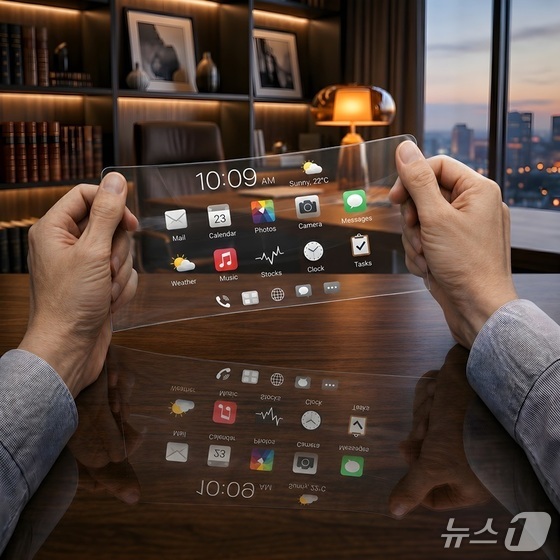
A breakthrough technology has been developed that could accelerate the commercialization of stretchable displays, which can expand freely like rubber.
On Wednesday, researchers from the Korea Advanced Institute of Science and Technology (KAIST) announced a significant advancement in stretchable display technology. Professor Yoo Seung-hyup’s team from the Department of Electrical and Electronic Engineering, in collaboration with Professor Moon Han-eul’s team from Dong-A University, successfully implemented an auxetic-based stretchable display platform. This innovative system maintains image integrity on the screen, allowing uniform stretching in all directions without distortion.
Conventional stretchable displays typically employ flexible substrates to implement light-emitting elements. However, these substrates have a inherent limitation: when stretched in one direction, they narrow in the perpendicular direction, causing text and images on the screen to appear flattened.
While auxetic structures have been applied to address this issue, most solutions only maintained the screen’s aspect ratio, leaving internal text and images still prone to distortion.
The research team proposed a novel design approach. Instead of adhering the auxetic structure to the entire flexible substrate, they used precise calculations to selectively connect it only where necessary.
In traditional methods, the twisting deformation that occurs as the auxetic structure stretches is directly transmitted to the substrate, distorting internal images. The new platform, however, allows each area to move uniformly outward from its original position. This preserves not only the overall aspect ratio but also the shape of smaller elements like text and images.
To verify the performance, the team conducted experiments involving repeated stretching of a substrate imprinted with characters and images in both horizontal and vertical directions. While the traditional method resulted in partial pattern deformation, the new platform maintained the stability of text and image shapes.
The researchers also integrated an light-emitting diode (LED) array onto this platform to confirm its viability as a functional stretchable display. Even when stretched up to 15% in both directions, the electrical flow remained stable and screen brightness consistent. After repeated 15% stretching cycles, brightness decreased by less than 2%, demonstrating its potential for real-world applications.
This technology is poised to become a core platform for next-generation electronic devices with flexible form factors, including wearable electronics, electronic skin, medical biosensors, soft robots, and curved displays for automobiles and aircraft.
The research team believes that combining this platform with inherently stretchable materials and light-emitting elements could lead to next-generation stretchable displays. These displays would maintain image quality even when users stretch them or adapt them to various environments.
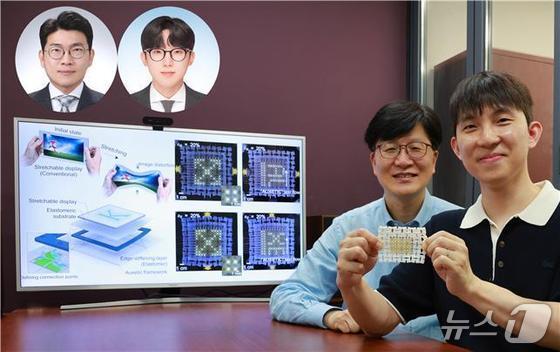
Professor Yoo emphasized that for stretchable displays to function as practical information display devices, they must not only stretch effectively but also maintain screen information accurately during the stretching process. This platform represents a key foundational technology that will accelerate the commercialization of high-resolution stretchable displays.
Dr. Kim Soo-bon and Dr. Kim Jun-ho from KAIST served as co-first authors, with Professor Moon and Professor Yoo as co-corresponding authors. The research has been published in the prestigious international journal Nature Communications.
The study was supported by several Korean research initiatives, including the Korea Research Foundation’s Mid-Career Researcher Support Program, the Future Display Strategic Research Project, the Korea Institute of Industrial Technology’s Future Core Technology Development Project, and the Korea Industrial Technology Promotion Agency’s Education and Training Support Program.