

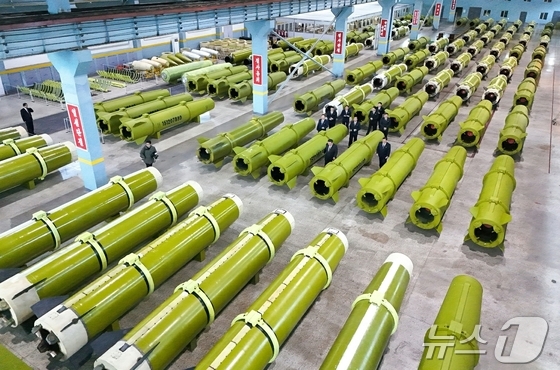
North Korea is seeking to revitalize its defense industry by leveraging military cooperation with Russia, according to an analysis by a state-run research institute. The report suggests that North Korea has increased its shell production to four times the normal level and improved weapon performance.
The analysis also raises the possibility of a triangular division of labor, where China supplies materials, parts, and equipment, Russia provides technology, fuel, and foreign currency, while North Korea contributes factories and labor.
According to the KDI North Korea Economic Review July 2026 published by the Korea Development Institute (KDI) on July 29, production activities have significantly increased in North Korea’s heavy chemical and defense industry-centered regions since North Korea-Russia cooperation intensified.
In 2024, as export volumes surged, production processes for 152mm artillery shell bodies were reportedly newly installed in local factories, including the 915 Factory and the Hyesan Forestry Machinery Branch Factory in Hyesan City, Yanggang Province, with production tasks assigned.
Last year, reports emerged that major defense factories in North Pyongan Province and Jagang Province, which produce short-range ballistic missiles and multiple rocket launchers, entered a 24-hour operation system.
North Korea claims that its shell production has increased to four times the normal level. KDI assesses that this figure may not be entirely exaggerated, considering external analyses suggesting that North Korea has sent millions of shells to Russia.
Qualitative improvements are also being made alongside quantitative increases. Evidence includes the improved accuracy of North Korean short-range missiles used by Russia in the Ukraine war and North Korea’s construction of large multipurpose ships, which was previously difficult to attempt.
While the report states that it’s unclear to what extent Russia has supported the overall hardware and software needed for weapons development, it’s evident that North Korea’s non-nuclear weapons systems and supporting defense industry have grown rapidly since North Korea-Russia cooperation began.
North Korea’s military cooperation is expanding beyond finished product transactions with Russia to encompass the entire weapons supply chain of authoritarian states.
It’s estimated that a triangular division of labor has formed, with China supplying materials, parts, and equipment, Russia providing technology, fuel, and foreign currency, while North Korea contributes factories and labor.
Considering the connection between drone production facilities in Russia’s Tatarstan Alabuga Special Economic Zone and drone-related facilities near Banghyeon Airfield in Gusong City, North Pyongan Province, there’s potential for cooperation to deepen into production process optimization and joint weapons system production.
However, weak industrial foundations, including power shortages, were identified as factors hindering the sustained growth of the defense industry. From January 2022 to October last year, the average nighttime luminosity in 178 cities, counties, and districts in North Korea increased by 25.9%, with traditional military areas prioritized for power supply.
This implies that power supply to defense factories comes at the expense of other industries and civilian life. Chronic power shortages and outdated power infrastructure could constrain the continued growth and advancement of the defense industry.
Russia’s selective technology transfer was also pointed out as a limitation. It was assessed that Russia has not sufficiently provided advanced technologies necessary for re-entry technology, Multiple Independently Targetable Reentry Vehicles (MIRV), nuclear submarines, and reconnaissance satellites, which North Korea presented at the 8th Party Congress.
The policy of simultaneously strengthening nuclear and conventional forces while pursuing economic construction could exacerbate economic difficulties. Continued concentration of resources in the military sector may lead to a contraction of the civilian economy and deterioration of living conditions, potentially undermining the national economic foundation supporting the defense industry in the long term.
The report identified the most dangerous possibility for South Korea as a scenario where North Korea achieves a resurgence in its defense industry without economic burden by expanding external cooperation to overcome resource and fuel shortages.
As North Korea’s capacity to invest resources in the defense industry without sacrificing the civilian economy grows with increased foreign currency earnings through weapons exports, the report suggests tracking not only the inflow routes of resources and fuel but also the export routes of North Korean weapons.
It further recommends that South Korea should lead efforts to increase the number of countries participating in the Multinational Sanctions Monitoring Team (MSMT) and refine the cooperation system to minimize surveillance gaps due to sanctions evasion. The report also emphasizes the need to review and reinforce South Korea’s own response posture, including counter-fire capabilities and early detection and interception systems.