
“Why can I receive stem cell treatment in Japan but not in Korea?”
This is one of the most common questions in the debate over stem cell treatments. Because treatments that are still permitted only on a limited basis in Korea can be obtained in Japan through self-pay medical services, a significant number of patients are spending tens of millions of won to seek treatment overseas. Korean companies have also continued to provide the same treatments in Japan, fueling calls for Korea to further ease its regulations.
The government, however, does not view “regulatory relaxation” and “expanding access to treatment” as synonymous. While it agrees that demand for overseas treatment should be brought back to Korea, it believes the solution lies not in adopting Japan’s approach to deregulation but in accumulating scientific evidence and gradually expanding access to treatments proven to be safe.
This approach is reflected in the recently announced “Second Basic Plan for Advanced Regenerative Medicine and Advanced Biopharmaceuticals” for 2026-2030. The government plans to pursue a two-track strategy: expanding treatment opportunities by directly supporting clinical research, while rationalizing regulations first for technologies with demonstrated safety and efficacy and tightening oversight of false or exaggerated advertising and regulatory blind spots.
Choi Kyung-il, director of advanced medical support at the Ministry of Health and Welfare, said in an interview with News1, “The goal of advanced regenerative medicine is to overcome disease,” adding, “Our basic direction is to promote both treatment and research while strengthening safety management.” He emphasized that “regulatory relaxation must also be pursued based on scientific evidence, while ensuring patient safety and efficacy.”
The following is an interview with Choi.
Stem cell treatments that are available in Japan remain limited in Korea. There are continued calls for further deregulation. How does the government view this?
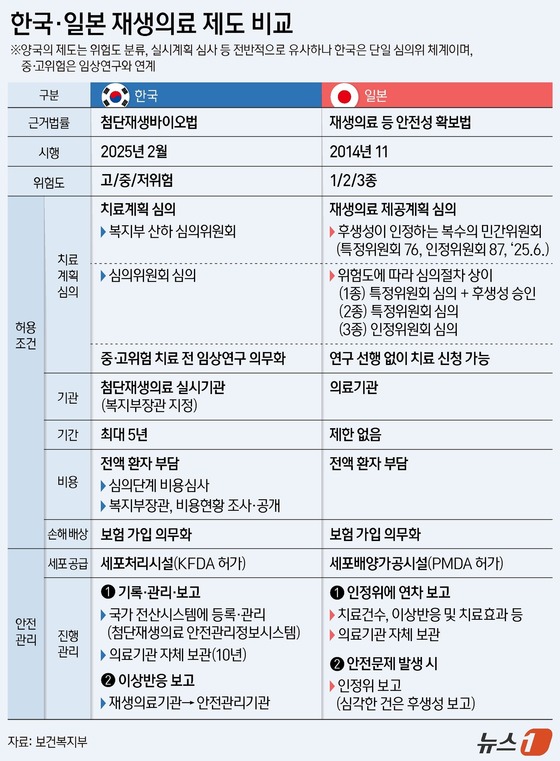
▶ There are indeed such calls. In particular, because Korean companies provide the same treatments in Japan but cannot do so in Korea, there have been demands to improve the system. Some have also questioned why patients should have to travel to Japan for treatment. However, Japan and Korea have fundamentally different systems.
Japan allows regenerative medicine to be provided as elective care based on agreements between patients and doctors and operates private review committees, among other differences. Korea, by contrast, operates within a national safety management system in which treatment can be provided after safety and efficacy have been verified.
Japan also appears to be moving to strengthen safety management of regenerative medicine.
▶ Japan has seen repeated accidents after broadly easing regulations, and I understand that its Ministry of Health, Labour and Welfare also believes regulations need to be strengthened. Japan has an institutional framework in which treatment is provided based on doctors’ professional judgment and patient consent.
In Korea, treatment is basically permitted under a system designed around the premise that safety must first be established. There was also a recent case in which a Korean patient who received stem cell treatment in Japan died. If something like that were to happen in Korea, it could have significant social repercussions. Such factors also influence how we operate the system.
In fact, Japan has broadly permitted regenerative medicine and attracted patients from overseas, including China and Korea, but it has recently shifted its policy toward strengthening regulations. In February, the International Society for Stem Cell Research (ISSCR) issued a warning letter urging Japan’s Ministry of Health, Labour and Welfare to comply with international guidelines. In March, the Japanese Society for Regenerative Medicine also issued a declaration calling for a clear distinction between regenerative medicine supported by scientific evidence and treatments that are not.
The government identified “regulatory rationalization” as a key task in the new basic plan. Does this mean something different from simply easing regulations?
▶ The basic direction is to promote treatment and research aimed at overcoming diseases through advanced regenerative medicine technologies while strengthening safety management at the same time. Any regulatory relaxation must also be based on scientific evidence. It must be pursued while confirming patient safety and efficacy. Promoting treatment and research and strengthening safety management must go hand in hand.
Cultured autologous immune cells were reclassified as low risk, but stem cells remain classified at the same risk level.
▶ We determined that sufficient research data and treatment cases have accumulated for cultured autologous immune cells and that their safety has been established. Following review by the committee, their risk level was lowered from moderate to low, and they are also classified as low risk in Japan. In contrast, experts determined that there is still insufficient literature and treatment data demonstrating the safety of autologous adipose-derived stem cells compared with immune cells. If more clinical research and treatment cases accumulate, we can consider adjusting the risk level following review by the committee.
What people most want to know is when they will be able to receive stem cell treatments in Korea.
▶ Government-led clinical research on knee osteoarthritis and intractable chronic pain could allow treatment plans to be reviewed as early as the second half of 2028.
However, government-led clinical research is not the only pathway. If researchers develop well-designed research plans and secure strong safety and efficacy data, I believe the widespread availability of stem cell treatments could come sooner. The government plans to conduct government-led clinical research to absorb overseas treatment demand domestically, while operating the system so that treatments supported by scientific evidence can be provided to patients within the national safety management framework.
Advanced regenerative medicine treatments can also impose a significant financial burden. What are the prospects for coverage under the national health insurance system?
▶ That will have to be considered gradually. For now, these treatments can only be provided outside national health insurance coverage. They are expensive treatments and carry significant risks. If their use expands to common diseases and they are shown to reduce health insurance spending and produce sufficient improvements in public health, that could provide grounds for considering insurance coverage. However, the current focus is on serious, rare and intractable diseases, so the number of patients is limited. Whether expensive treatments should be covered universally is a separate policy question. To qualify for national health insurance coverage, treatments need not only to demonstrate efficacy but also effectiveness. That aspect must also be considered.
The government also plans to strengthen oversight of institutions providing these treatments alongside efforts to expand access.
▶ Previously, medical institutions could be designated as advanced regenerative medicine institutions if they met requirements for treatment plans, facilities, personnel and equipment. However, some institutions obtained the designation but did not actually conduct research or provide treatment and instead used the designation in advertising. That is why we began monitoring designated institutions in the second half of last year, and that monitoring is continuing. Going forward, we plan to revise the system so that a designation can be revoked if an institution does not submit a clinical research or treatment plan within one year of designation. We also plan to introduce a designation renewal system under which facilities, personnel, research performance and completion of training will be reassessed every three years.
We will also continue to monitor false and exaggerated advertising. We will regularly monitor advertising specifically related to advanced regenerative medicine and establish advertising guidelines to reduce cases in which patients are misled into believing that the government has guaranteed the safety of a treatment. We will continue inspections in cooperation with the Korea Regenerative Medicine Agency, including at clinic-level medical institutions, and strictly apply penalties available under the law. We must prevent incorrect information from reaching patients.
Five years have passed since the Advanced Regenerative Bio Act took effect. What are the most common concerns you hear from the field, and what issues need to be addressed going forward?
▶ Advanced regenerative medicine is an area where it is difficult to safely secure patient access to treatment using only the existing regulatory frameworks for pharmaceuticals and medical devices. That is why the Advanced Regenerative Bio Act was enacted to establish a separate institutional pathway. Korea has a systematic safety management framework compared with other countries, including a designation system for treatment institutions and a safety information management system.
However, as the system is still in its early stages, it is true that there are various opinions and difficulties in the field. One of the most common concerns is that it is difficult to pass the review process. We plan to narrow the gap between researchers and the review system by developing review guidelines and providing consulting on the preparation of research and treatment plans. We will continue to improve the system based on needs from the field.