

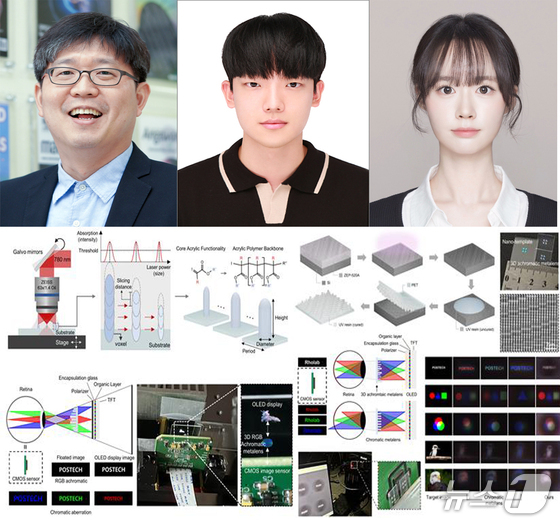
On Tuesday, Pohang University of Science and Technology (POSTECH) announced that a research team led by Professor Noh Jun-seok from the Graduate School of Convergence of Mechanical, Chemical, and Electronic Electrical Engineering has developed Meta lens technology that is thinner and lighter than existing augmented reality (AR) and virtual reality (VR) devices.
The team has created a production method that allows for precise control of nanostructure heights, enabling mass production of clear, full-color Meta lenses without color bleeding. This technique can simultaneously produce nanostructures of varying heights.
Meta lenses, which use densely arranged nanostructures to focus light in desired directions, are crucial components in AR and VR glasses. However, achieving achromatic performance that accurately converges red, green, blue (RGB) light to a single point using low-refractive-index materials has been a significant challenge.
The team’s breakthrough involves adjusting the height of nano-pillars that make up the Meta lens to precisely focus RGB light at desired points.
Professor Noh explained that by leveraging three-dimensional nanostructures and applying cost-effective materials and production processes, it can enhance both the performance and productivity of Meta lenses. This technology has broad applications, from creating slimmer and lighter AR and VR glasses to improving imaging in next-generation displays, cameras, and optical sensors.