


Years after the U.S. blocked exports of advanced artificial intelligence (AI) semiconductors to China, the country’s leading AI models are still being built on NVIDIA graphic processing units (GPUs). Despite China’s push for semiconductor self-sufficiency, NVIDIA’s dominance in cutting-edge AI development remains strong.
However, the landscape is shifting for AI models. Chinese offerings like Moonshot AI’s Kimi K3, Alibaba’s Qwen 3.8 Max, and Zhifu AI’s GLM-5.2 are rapidly closing the performance gap with top U.S. models. They’re gaining traction globally by adopting an open-weight strategy, sharing model weights publicly to attract developers and researchers worldwide.
Industry reports from Monday indicate that NVIDIA GPUs are still widely used in training China’s most advanced AI models.
The U.S. has long restricted high-performance GPU exports to hinder China’s AI progress. While Beijing encourages domestic AI chip use, replacing NVIDIA in cutting-edge model development remains challenging.
China is working to create a software ecosystem to rival NVIDIA’s CUDA, centered on Huawei’s CANN. However, companies face significant costs and time investments to switch from NVIDIA, given the entrenched CUDA-based software and developer ecosystem built over years.
The South China Morning Post noted that NVIDIA’s CUDA ecosystem has long been the industry standard, emphasizing that a shift to Huawei’s CANN would require extensive code rewriting and optimization.
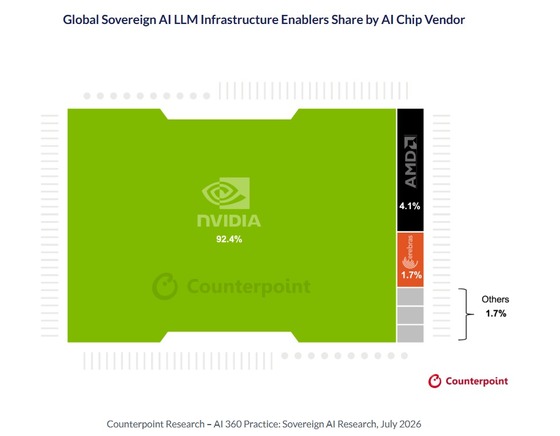
NVIDIA dependence isn’t unique to China. Counterpoint Research recently found that 92.4% of over 170 AI models from 55 countries, excluding the U.S. and China, use NVIDIA AI chips for training or inference.
While GPU Access Restricted, China Expands its Influence Through Model Development
The AI model race highlights China’s impressive strides.
In 2025, DeepSeek shook up the AI industry with a cost-effective, high-performance model. Now, several Chinese models are catching up to top U.S. offerings.
Some in the U.S. worry Chinese firms are using ‘distillation’ to enhance their models using American AI. However, China’s open-weight strategy, allowing anyone to download and modify model weights, is gaining significant traction in the global AI ecosystem.
Chinese open-weight models are seeing increased adoption in research settings.
A recent University of Stuttgart study, analyzing over 21 million academic papers from 2023 to June 2024, found that 44% of studies using a single AI model lineage chose open-weight models.
Of these, Chinese models accounted for 60.5%. Alibaba’s Qwen was used in 22% of single-model studies, far outpacing Meta’s LLaMA at 8.6%.
While U.S. firms lead in cutting-edge AI chips and software ecosystems, Chinese models are rapidly gaining ground in the open-weight model space, actively chosen by researchers and developers.
U.S. Restricts GPUs, China Expands Via Models: AI Power Struggle Intensifies
This trend reveals both the limits of U.S. AI controls on China and China’s ongoing challenges.
The U.S. limits China’s computing resources by controlling NVIDIA’s advanced GPU supply. Given CUDA’s entrenched ecosystem, U.S. dominance in AI computing is hard to challenge short-term.
China must develop advanced models while reducing reliance on U.S. firms for core computing. This drives the need to build hardware and software ecosystems around domestic chip makers like Huawei.
The U.S. finds it harder to contain China’s AI ecosystem solely through GPU restrictions. Chinese firms are enhancing models despite limited computing resources, while gaining users globally through open-weight strategies.
The U.S.-China AI race now pits America’s edge in computing infrastructure against China’s growing influence in open-weight models. Key factors include how long the U.S. can maintain GPU-based tech control and how quickly China can reduce NVIDIA dependence.