

Deepnoid has validated its artificial intelligence (AI) technology for analyzing cerebrovascular images through an international benchmark.
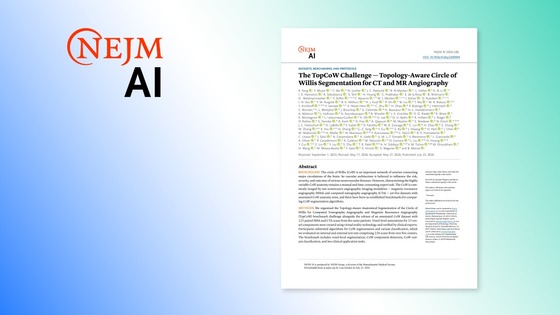
A research paper on an international benchmark study of AI for cerebrovascular segmentation, in which a Deepnoid research team participated, was published in NEJM AI, an international medical AI journal, the company said Aug. 19.
The study presents the comprehensive results of the international cerebrovascular AI benchmark challenge TopCoW. TopCoW is an international research initiative that compares the performance of AI algorithms in automatically detecting, segmenting and classifying the Circle of Willis, a network of major arteries in the brain, using computed tomography angiography (CTA) and magnetic resonance angiography (MRA) images.
More than 250 participants from six continents took part in the challenge, with 25 teams ultimately submitting algorithms. Deepnoid ranked second in detection, third in segmentation and fourth in classification among the individual tasks. Deepnoid was also the only South Korean company among the institutions affiliated with the paper’s authors.
The researchers built a dataset using CTA and MRA images from the same patients, with 13 cerebrovascular segments marked at the voxel level, the basic unit of three-dimensional imaging. This provided a standardized benchmark for objectively comparing the performance of cerebrovascular AI, moving beyond existing evaluation methods that varied by institution or algorithm.
The study also validated the technology’s potential for clinical application. In an analysis of 12 cerebral aneurysm cases, the technology accurately identified the locations in 10 to 12 cases. Its precision and recall in classifying fetal-type posterior cerebral arteries were also around 80%.
Deepnoid said the cerebrovascular segmentation technology validated in the study is being applied to DEEP, its AI solution for assisting in the interpretation and diagnosis of cerebral aneurysm images.
DEEP was selected as an innovative medical technology in 2023 and received a non-covered health insurance code in 2024. Based on the latest research results, the company plans to further improve the product’s performance and expand the technology into brain foundation models and medical AI agents.
“the cerebrovascular segmentation technology validated in this international study has already been applied to Deepnoid’s brain imaging AI product DEEP and is being used in actual clinical settings,” Deepnoid CEO Choi Woo-sik said. “We will continue to expand into follow-up research, including brain foundation models, and maintain our competitiveness in brain imaging AI.”
Meanwhile, Deepnoid held a media day in July and presented its vision of becoming a medical AI services company encompassing medical AI solutions, infrastructure and agents, starting with M4CXR and expanding its modalities to chest CT and MRI.
Deepnoid plans to integrate AI agent capabilities into AxonFlow, advancing it beyond simple diagnostic support into a platform-as-a-service that supports healthcare institutions across their overall operational processes.