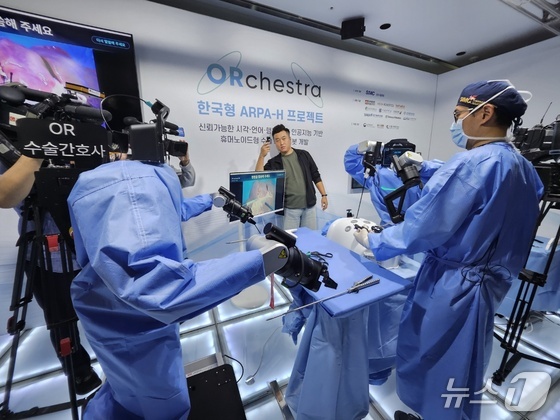
“Give me the scissors.”
As soon as the surgeon finished speaking, the robotic arm sprang into action. It swiftly picked up the scissors from the array of surgical tools on the tray and delivered them directly to the doctor’s hand.
Moments later, the scene reversed.
“Take the tools.”
This time, the robot collected and neatly organized the used surgical instruments.
These actions unfolded in mere seconds. While such choreography is commonplace in operating rooms, today’s performance had a twist: the entity responding to the surgeon’s commands wasn’t a nurse or resident, but a humanoid robot assisting in surgery.
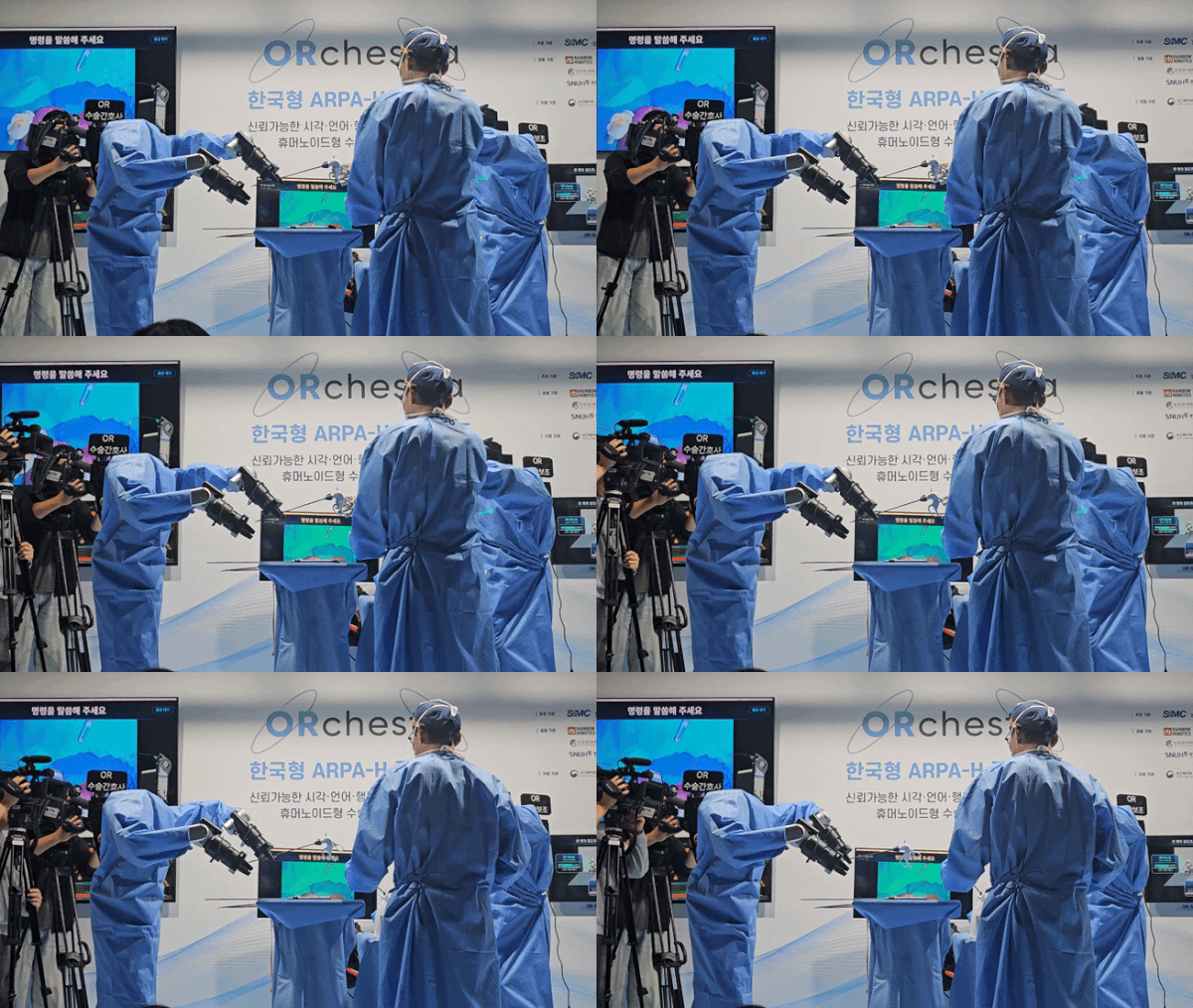
On Wednesday, at the Samsung Life Building near Ilwon Station in Seoul’s Gangnam district, a groundbreaking demonstration unfolded. Samsung Medical Center showcased a humanoid surgical assistance robot, with a human doctor and two robotic counterparts teaming up to perform a simulated cholecystectomy.
In place of a human patient, a goat’s liver lay on the operating table. The laparoscopic screen displayed real-time imagery of the gallbladder and blood vessel structures. One robot played the role of a nurse, deftly handling surgical tools, while the other maintained the laparoscope’s position and assisted with tissue manipulation, mirroring the duties of an assistant surgeon.
The lead surgeon directed the robots solely through voice commands. “Closer,” he’d say. “A little deeper.”
With each instruction, the robots adjusted their positions and actions precisely. The lead surgeon proceeded to dissect the gallbladder, clip blood vessels, and remove the organ, following the same meticulous steps as in a real operation.
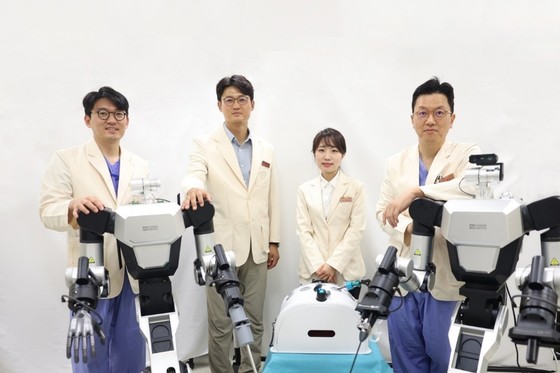
These robots are the fruits of the Operating Room Collaborative Humanoid (ORchestra) project, an ambitious initiative aimed at developing humanoid surgical assistants capable of seamlessly integrating with medical staff in operating rooms. The project, backed by Korea’s ARPA-H program under the Ministry of Health and Welfare, brings together a powerhouse team including Samsung Medical Center, Rainbow Robotics, AIDIN Robotics, Seoul National University, Sungkyunkwan University, the National Cancer Center, and Jeonbuk National University Hospital.
While not showcasing a finished product, the demonstration offered a tantalizing glimpse into the operating room of tomorrow. The significance of the event transcended mere technological showmanship. As medical staff issued commands and humanoid robots responded in real-time, the researchers’ vision of future surgical environments began to take tangible shape.
The research team drew an intriguing parallel to the movie Real Steel. Just as the film’s robots learned to mimic human boxing movements, these humanoid assistants are designed to absorb and replicate the intricate motions of seasoned medical professionals.
Dr. Jung Yong-ki, an ENT specialist at Samsung Medical Center, explained that the humanoid surgical assistant translates human hand and arm movements into its own coordinate system. This allows for incredibly precise surgeries, breaking down the surgeon’s commands into minute, controllable actions.
Transforming Operating Rooms into Data Factories: Learning Even the Surgeon’s Hand Movements
The project’s ambitions extend far beyond creating mobile robotic arms. The research team is reimagining the entire operating room as a Surgical Data Factory.
Dr. Jung elaborated that they’re working to convert the tacit knowledge surgeons accumulate through years of practice into quantifiable data.
Ceiling-mounted cameras capture the medical team’s movements in exquisite detail. Wearable sensors record the nuanced motions of hands and fingers. Laparoscopic footage is meticulously categorized into Action Triplets, denoting specific surgical scenes, instrument usage, and procedural steps.
Currently, four institutions, including Samsung Medical Center, are amassing this data using standardized protocols. After obtaining informed consent and thorough anonymization, the information fuels artificial intelligence (AI) learning algorithms. This data goes far beyond simple commands like “pick up the scissors.” The research team has already developed and published an algorithm that can predict the next surgical step and required instruments based on laparoscopic imagery alone. Their long-term vision includes robots that proactively prepare tools before the surgeon requests them, anticipating needs based on a deep understanding of surgical flow.
Challenges remain, however. Dr. Jung noted that while the AI can accurately predict next steps based on general surgical scenes, it doesn’t yet account for the subtle technique variations between individual surgeons. He emphasized the need for a comprehensive AI model capable of grasping the full context of an operating room environment.
Elon Musk’s Bold Prediction: Replacing Surgeons in Three Years – How Close Are We to Reality?
Reporters naturally steered the conversation towards the global race in surgical AI, particularly referencing Elon Musk’s provocative claim last year that AI would replace surgeons within three years. Dr. Jung responded thoughtfully that while dramatic, Musk’s statement isn’t entirely without merit.
He pointed to a study published in Science Robotics last year, where an AI system called SRT-H (Surgical Robot Transformer-Hierarchy) successfully performed a cholecystectomy on porcine tissue. Dr. Jung noted, however, that this was conducted on extracted organs, not living subjects.
More recently, in July, researchers from UC San Diego published groundbreaking results in Nature. Their study demonstrated a humanoid robot performing surgery on a pig model via remote control.
Dr. Jung contextualized Musk’s statement: It’s best understood as a declaration of direction, not an exact timeline. While surgeons won’t vanish in three years, it’s clear it’s moving towards increased AI integration in surgery.
He highlighted their unique approach: The Nature study used a remotely controlled humanoid, with human surgical assistance. The setup, combining a teleoperation robot with two humanoid assistants as a cohesive surgical team, is truly pioneering.
Dr. Oh Nam-ki, from Samsung Medical Center’s transplant surgery department, expressed confidence in South Korea’s position: The collaboration between skilled medical professionals and multiple robots they’re demonstrating is globally unprecedented. By marrying the surgical expertise with cutting-edge robotics and AI, South Korea has the potential to lead this transformative field.
From Laboratory to Operating Room: Charting a Course for Clinical Trials by 2029
The team is currently in the technology validation phase, supported by an initial budget of 1.4 billion KRW (roughly 1.01 million USD). Pending a competitive evaluation later this year, they stand to secure an additional 12 billion KRW (about 8.7 million USD). The project’s total scope, including government research and development (R&D) funding, approaches 13.8 billion KRW (about 9.98 million USD).
Dr. Jung elaborated on the budget’s comprehensive nature: This covers not just robot development, but the full spectrum – clinical trials, safety protocols, legal and regulatory research, usability studies, and demonstration costs. It’s a collaborative effort, with each institution contributing its own resources beyond government funding.
Questions arose about post-commercialization economics, particularly whether humanoid assistants could truly be more cost-effective than human staff.
The research team sees strong economic potential, especially given healthcare’s persistent labor shortages. Dr. Jung explained that maintaining 24/7 coverage actually requires more than five human staff members. If a humanoid can match one nurse’s capabilities, the return on investment could be relatively quick. He cautioned, however that the key is achieving performance truly comparable to human roles.
The team has set 2029 as their initial target for clinical implementation. They plan a phased approach, starting with lower-risk tasks like endoscope positioning and maintaining surgical visibility. This would progress to tissue retraction and more complex assistance, with advanced procedures like incisions and suturing requiring additional development time.
The researchers emphasize their clear vision: creating collaborative team members to enhance, not replace, human surgical staff.
Dr. Jung concluded that humanoid surgical assistants could be game-changers in challenging environments or for repetitive, physically demanding tasks. This technology has the potential to create safer surgical conditions for patients, optimize operations with limited personnel, and fill crucial gaps in night shifts, emergencies, and essential services where skilled human assistants are scarce.