The U.S. stock market’s recent upward trend has reignited domestic investors’ interest in American investments. This surge isn’t limited to local investors; global investors are also flocking to U.S. stocks, resulting in the highest capital inflow into the American stock market in over four decades.
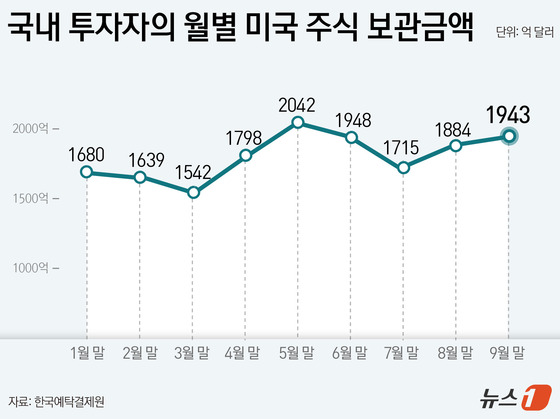
Data from the Korea Securities Depository on October 4 revealed that domestic investors held U.S. stocks valued at 194.3 billion USD as of September 30. This represents a significant 20% increase from the 161.5 billion USD recorded just two months earlier on July 29.
The value of U.S. stocks in domestic portfolios has seen a steady climb, rising from 154.2 billion USD at March’s end to 204.2 billion USD by May’s close. Despite a dip to 171.5 billion USD in late July, it rebounded strongly, reaching 199.4 billion USD by September 22, edging close to the 200 billion USD mark once again.
Market analysts attribute this trend to the attractive returns offered by U.S. equities. In the roughly two-month span from the recent low on July 29 to October 1, the S&P 500 index gained 4.8%, while the Nasdaq Composite surged by 9.9%. Notably, the U.S. market’s dominance in growth sectors like artificial intelligence (AI) continues to bolster investor confidence.
Exchange-traded funds (ETFs) are also benefiting from this influx of domestic retail investment. Koscom CHECK reported on October 2 that the top-performing equity ETFs by net inflows over the past month were all U.S.-focused: TIGER U.S. S&P 500 (665.2 billion KRW or about 495 million USD), KODEX U.S. S&P 500 (421.4 billion KRW or about 314 million USD), KODEX U.S. Nasdaq 100 (357.1 billion KRW or about 266 million USD), and TIGER U.S. Nasdaq 100 (288.3 billion KRW or about 215 million USD).
This growing appetite for U.S. investments isn’t unique to domestic investors. The Financial Times reports that foreign investors net purchased 942 billion USD worth of U.S. stocks and investment fund shares from August last year through July this year. This figure marks the highest inflow since the U.S. Treasury began tracking such data in 1985.
Brad Setser, a senior fellow at the Council on Foreign Relations, noted the unusual nature of this trend, particularly for South Korean investors. It’s unprecedented to see over 200 billion USD flowing out of South Korea into global stocks, Setser remarked. He suggested that as domestic heavyweights like Samsung Electronics and SK Hynix gained momentum, investors sought to diversify their portfolios with U.S. equities.
Interestingly, U.S. bonds haven’t enjoyed the same level of enthusiasm. Despite rising interest rates, stocks remain more appealing than U.S. Treasuries, likely due to concerns over the country’s substantial fiscal deficit. The Korea Securities Depository reported a 19.4% decrease in U.S. bonds held by domestic investors, falling from 19.4 billion USD at January’s end to 15.6 billion USD by September’s close.
Market watchers advise keeping a close eye on the Middle East conflict’s potential ripple effects. Choi Kyu-ho, an analyst at Hanwha Investment & Securities, cautioned that the economic pressures from the war will persist in the near term. Volatile energy prices are driving up production costs, intensifying financial strains. However, Choi remains optimistic, noting that the risk of a broad economic downturn appears low. It’s seeing rebounds in new orders and employment, and with consumer inventories at low levels, there’s still potential for restocking demand.
The upcoming U.S. midterm elections, now just a month away, are another focal point for investors. Kim Seok-hwan, a researcher at Mirae Asset Securities, observed that while the overall economy remains resilient, households are feeling the pinch of increased costs. This economic pressure is shaping the political landscape as it approaches the midterms. Kim emphasized the importance of monitoring post-election policy shifts, particularly those addressing living expenses.