
Jeff Rosen, president of the Hyundai Motor America Dealer Association, emphasized on Monday that Hyundai aims to become a mainstream brand recognized for its value and price. This will be achieved through product competitiveness, customer experience, and long-term trust, moving beyond being simply a value-for-money brand.
During an interview at the global premiere of the All-New Tucson, Rosen stated that Hyundai has been the third fastest-growing mass-market brand in the U.S. over the past five years.
The most popular model is the 2026 All-New Palisade, which includes internal combustion and XRT models along with the newly added hybrid option for 2025.
Rosen noted that thanks to premium materials, first and second-row relaxation seats, and exceptional quietness, the interior creates an atmosphere comparable to a luxury vehicle.
He also highlighted features such as seating for up to eight, 100W USB-C ports for every seat, a dual-camera dashcam, and ten airbags as key strengths.
Regarding the All-New Tucson, which made its global debut in New York, he called it the most daring change in the model’s history. New features include high-resolution H-Edge lighting, deep-drawing steel body panels, and a clamshell hood.
He remarked that the Tucson enjoys support from a wide customer base, ranging from young individuals to families with children and retired couples. This new model will attract an even broader audience.
He expressed excitement about the Santa Fe extended-range electric vehicle (EREV) set to launch in the first half of next year.
Rosen explained that Hyundai’s first EREV provides the same driving experience as a pure electric vehicle (EV) while optimally integrating battery and engine control to achieve over 600 miles (about 960 km) of range.
The key lies in the battery. Hyundai uses its own high-performance battery to deliver electric vehicle-level power and performance with less than half the battery capacity of comparable battery electric vehicles (BEVs).
He added that it can significantly reduce production costs, ensuring price competitiveness against rival models. Because we produce in the U.S., it can secure a stable supply chain and are likely to meet federal EV tax credit requirements.
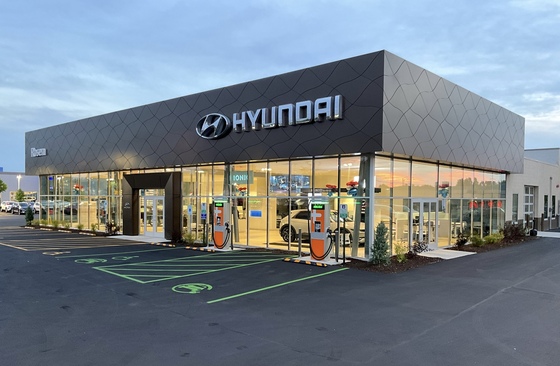
U.S. Rapidly Expanding Hybrid Market… Hyundai Expands Hybrid Models to Over 18
Rosen identified the rapid growth of hybrid vehicles as the most significant change in the U.S. market recently.
He observed that customers are now much more careful in considering monthly payments, fuel efficiency, total cost of ownership (TCO), and whether the vehicle fits their lifestyle.
He continued that from January to September this year, Hyundai’s hybrid sales increased by 54% compared to the same period last year, accounting for 27% of total sales. The share of EVs, combining hybrids and pure EVs, has reached 33%.
Rosen pointed to the rapidly expanding lineup, driving feel, and premium technology specifications as the competitive strengths of Hyundai’s hybrids.
He specifically noted that the next-generation hybrid system TMED-II improves fuel efficiency by 4.3% and significantly enhances performance. It will also be included in upcoming rear-wheel-drive luxury models.
Hyundai plans to increase the share of electrified vehicles to 60%, aiming to sell 5.55 million units globally by 2030, with plans to expand its hybrid models to over 18.
He refrained from commenting on the impact of the expiration or reduction of EV tax credits. Instead, he emphasized that regardless of how policies change, Hyundai’s principles remain unchanged.
He added that it will continue to develop eco-friendly, low-carbon vehicles that provide real choices for customers while ensuring that more people can realistically purchase and maintain them.