

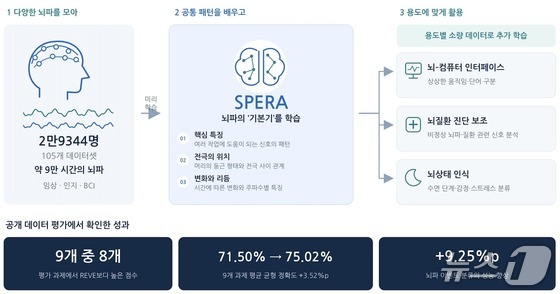
Hanyang University announced on Tuesday that a research team led by Professor Lim Chang-hwan from the Department of Biomedical Engineering has developed an artificial intelligence (AI) model called SPERA. This innovative model can analyze various brainwave patterns, including those related to sleep and emotional states. In performance comparisons across 9 open evaluations, the team’s model outperformed the existing top-performing model in 8 categories.
SPERA is a foundation model that pre-learns common features from numerous individuals’ brainwaves and can be further fine-tuned for specific applications. This approach significantly reduces the need to train AI from scratch for each new technology, such as sleep state analysis or emotion recognition.
The team utilized an extensive dataset comprising 29,048 individuals’ brainwaves, grouped into 106 datasets. With approximately 80,000 hours of total recording time, the model was trained to recognize a wide spectrum of brainwave variations across different individuals and measurement equipment.
In performance comparisons, SPERA achieved an average balanced accuracy of 75.02%, surpassing the previous top-performing model, REVE, by 3.52 percentage points. Even in the sole category where it slightly underperformed – depression-related brainwave classification – the difference was a mere 0.07 percentage points.
SPERA also demonstrated remarkable efficiency in learning new tasks with limited data. In sleep stage classification evaluations, it outperformed REVE while using only 5% of the data typically required for additional training. This breakthrough could potentially slash the time and costs associated with obtaining expert-labeled brainwave data.
The learning approach focused on identifying crucial features within complex brainwave signals. By predicting key characteristics rather than reconstructing entire signals, the model minimized the burden of learning noise from eye blinks or muscle movements. It also accounted for signal variations due to electrode placement, temporal changes, and both rapid and slow rhythms.
This groundbreaking technology is expected to have wide-ranging applications, from brain-computer interfaces (BCIs) that transmit commands via brainwaves to software aiding in brain disorder diagnosis. It could also serve as a foundational tool for assessing sleep quality and monitoring emotional and stress states.
The research is set to be presented at the prestigious AI conference NeurIPS 2026 in Sydney, Australia, on December 10. Kim Min-soo, a doctoral candidate in Hanyang University’s Department of Convergence Electronic Engineering, is the lead author, with Professor Lim as the corresponding author. The study received support from Samsung’s Future Technology Development Project.
Professor Lim emphasized the global significance of this development, stating that brainwave foundation models are becoming a crucial common base for various brain engineering technologies, sparking intense global competition. It anticipates that the independently developed SPERA will emerge as a leading model, driving worldwide advancements in brainwave AI research and application technology.