

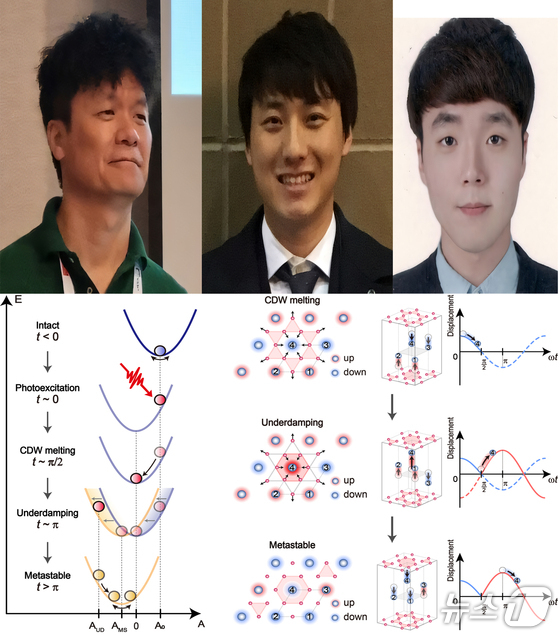
Researchers from Pohang University of Science and Technology (POSTECH) made a groundbreaking discovery. A team led by Professor Changyong Song from the Department of Physics, along with Seungpil Heo from the integrated program and Professor Dongbin Shin from the Department of Physics and Photon Science at Gwangju Institute of Science and Technology (GIST), observed for the first time a phenomenon where atomic vibrations are suppressed within a special metal.
Atoms that constitute matter typically vibrate in a rhythmic, dance-like manner. Scientists call these vibrations phonons. Far from being mere movements, phonons play a crucial role in various material properties. They influence how electricity flows, how heat transfers, and even contribute to superconductivity. However, under certain unique conditions, these vibrations can abruptly cease or face disruption.
To unravel this mystery, the research team employed cutting-edge technology at the Pohang Accelerator Laboratory (PAL-XFEL). They conducted a femtosecond time-resolved X-ray scattering experiment, capable of capturing events occurring in one quadrillionth of a second.
Their findings revealed a fascinating scenario: atoms, seemingly eager to dance, were constrained by the orderly arrangement of electrons. The researchers aptly named this phenomenon “phonon frustration.”
This discovery isn’t limited to a single type of material. Its implications extend to superconductors, quantum computing materials, and other complex substances.
The scientific community has hailed this research as a significant breakthrough. It provides vital clues for understanding materials that will be pivotal in future technologies, particularly in the realms of superconductivity and quantum materials.
Professor Song stated that it’s the first experimental confirmation of the interaction between electrons and phonons. He emphasized that their findings will serve as a crucial key to understanding and manipulating complex quantum materials.