

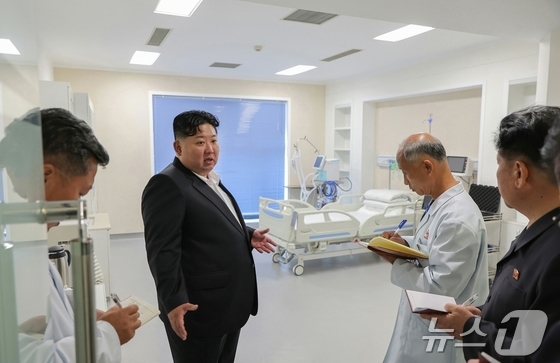
Kim Jong Un, General Secretary of North Korea’s Workers’ Party, visited the Wonsan-Kalma Coastal Tourist Area to inspect the newly built tourist railway station and emergency treatment center. He issued directives for nationwide railway station modernization, stricter construction quality control, and improvements in medical facility operations.
On Friday, the party’s official newspaper, Rodong Sinmun, reported that Kim conducted an on-site inspection of newly constructed facilities in the Wonsan-Kalma Coastal Tourist Area on Wednesday. Key officials from the Workers’ Party Central Committee and top brass from the Korean People’s Army accompanied him during the visit.
Kim toured the newly constructed Kalma Tourist Railway Station, assessing its construction progress and operational readiness. He commended the builders, noting that a modern railway station had been erected in just one year, and praised how the station’s architectural elements aligned with the Party’s aesthetic principles and practical design guidelines.
He stressed the importance of balancing technical and architectural designs in railway station construction, outlining principles to ensure scientific, functional, and professional aspects of railway infrastructure design. Kim also pointed out some deficiencies in the finishing work, emphasizing the need to improve quality management systems, strengthen construction oversight, and enhance the technical skills of the workforce.
Furthermore, he called for bolstering the role of construction supervisory agencies and suggested ongoing improvements to construction laws, including legally mandating that construction firms be responsible for building quality for a specified period.
Drawing from this experience, Kim proposed modernizing railway stations in provincial capitals nationwide. He ordered the preparation of scientific designs and budgets that consider regional passenger and freight transport capacities and functional characteristics. Additionally, he instructed officials to secure necessary vehicles and equipment for station operations and to specialize in the planning and operation of tourist trains.
Subsequently, he visited the newly built emergency treatment center in the Wonsan-Kalma Coastal Tourist Area, inspecting various facilities including the emergency resuscitation room, operating room, observation room, and laboratory to evaluate the construction status.
Kim directed that the emergency treatment center be fully staffed with medical personnel to enhance service quality. He identified some flaws in the facility’s internal layout and design, emphasizing the need to establish a systematic approach from the initial technical planning phase and strengthen coordination among design, construction, and operational units to improve the facility’s functionality and specialization.
He particularly highlighted the need to build modern hospitals in 20 cities and counties annually, stressing the importance of enhancing design expertise and ensuring that the entire construction process—from design and review to agreement and budgeting—adheres to scientific and regulatory procedures as outlined in construction laws.
Additionally, Kim outlined tasks for improving the emergency treatment center’s operations and medical services, including ensuring a stable supply of essential medicines, medical equipment, and consumables for emergency care.