

On Sunday, it emerged that North Korea, which declared a health revolution last year, is now actively promoting the modernization of medical technology alongside the completion of hospitals in various regions.
North Korea’s external propaganda radio outlet, Voice of Korea, recently aired a program titled “Challenging the Impossible,” featuring the head of the Stem Cell Research Laboratory at the Oncology Research Institute under the North Korean Academy of Medical Sciences. The broadcast claimed that the researcher had identified effective treatment methods to inhibit tumor growth, drawing on extensive clinical experience.
According to the program, the researcher developed treatments to activate the functions of diseased organs, enhance metabolism, and suppress tumor growth. These methods were reportedly validated through more than ten nationally recognized scientific and technological achievements.
The researcher said the work was driven by a desire to ease the suffering of cancer patients living in despair and anxiety. He noted that while the treatments showed meaningful results in early-stage cancer cases, limitations remained for patients who were not candidates for surgery or who experienced recurrence after surgery.
He also explained that by tailoring treatment approaches to individual patients’ physical conditions and actively applying them in clinical settings, he gained proficiency across a range of cancer treatment methods.
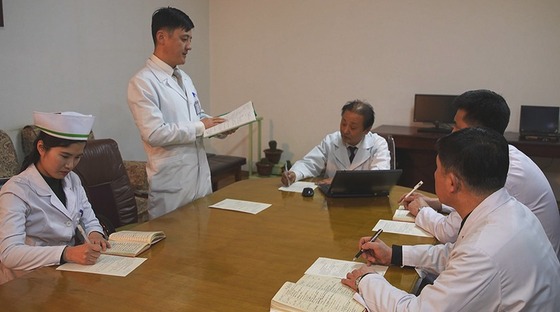
In another broadcast titled “Skilled Medical Team,” medical staff from the abdominal surgery department at Mangyongdae Hospital touted their successful performance of complex surgeries, including those for bile duct cancer.
The broadcast noted that abdominal cancer surgeries in the past were time-consuming and carried significant risks of postoperative complications. To address these challenges, the medical team reportedly conducted hundreds of discussions, consultations, animal experiments, and simulated surgeries.
According to the broadcast, the team developed more than ten new surgical techniques, including methods for lower bile duct cancer. These advances reportedly reduced surgery times from eight to ten hours to five to six hours, while maintaining patient safety.
Meanwhile, the January issue of the external propaganda magazine Kumsugangsan spotlighted medical devices developed by the Medical Equipment Research Institute under the Ministry of Public Health. The institute was said to have refined multiple technologies while lowering development costs.
These devices include UV therapy machines, carbon phototherapy devices, and cervical massage therapy devices suitable for home and office use. Last year, they also developed over 10 types of medical devices and consumables, including intravenous laser treatment devices, electronic rectoscopes, ophthalmic cryosurgery devices, ultrasonic wound-cleaning machines, and biodegradable magnesium alloys for biomedical applications.
Kim Jong Un, the General Secretary of the Workers’ Party of Korea, declared 2025 the Year of the Health Revolution and outlined the country’s healthcare capabilities on four pillars: medical facilities, medical equipment, healthcare personnel, and pharmaceutical supplies. North Korea plans to build model regional hospitals in Gangdong County, Guseong City, and Yonggang County, with nationwide expansion slated to begin in 2026.