

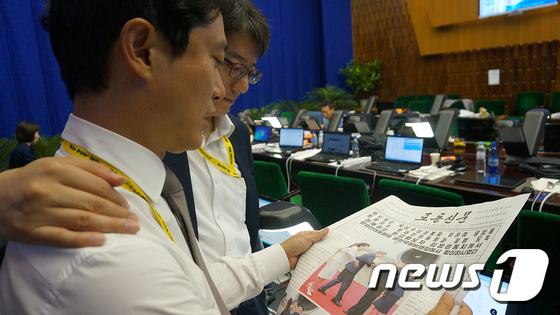
The government is intensifying efforts to open North Korean materials and media, including Rodong Sinmun, to the general public. Concurrently, discussions on related legislation are ongoing in the National Assembly, particularly among ruling party lawmakers.
News1 reports that on Wednesday, Lee Jae Gang, a Democratic Party member of the National Assembly’s Foreign Affairs and Unification Committee, plans to introduce a bill titled “Partial Amendment to the Act on Promotion of Information and Communication Network Utilization and Information Protection.”
The bill’s main objective is to add a clause stating that information related to North Korea is exempt from the prohibition on the circulation of illegal information under the current Information and Communication Network Act.
Article 44-7, Section 1, Clause 8 of the existing Act prohibits the circulation of information related to activities banned under the National Security Act. This amendment would, under exceptional circumstances, allow North Korean media and materials.
In explaining the bill’s rationale, Lee Jae Gang said that achieving peaceful unification, as envisioned by the Constitution, begins with an accurate understanding of North Korea. He noted that society has reached a level of civic maturity that allows citizens to independently assess information about North Korea, adding that by guaranteeing the public’s right to know, the aim is to expand opportunities for a proper understanding of North Korea and to foster more rational perceptions of both North Korea and unification.
Previously, on December 12, Democratic Party Representative Han Min Soo introduced an amendment to the Information and Communication Network Act. This earlier proposal sought to partially relax the existing law, which prohibited access, viewing, and circulation of information banned under the National Security Act, by allowing access and viewing.
However, some critics have expressed concerns that the language in these amendments is overly broad. They worry it might lead to the opening of various content violating the National Security Act, beyond just North Korean media and materials.
In response, Lee Jae Gang’s office has clarified that their additional proposal will specifically permit access and viewing of only North Korea-related information among the various types of information prohibited by the National Security Act.
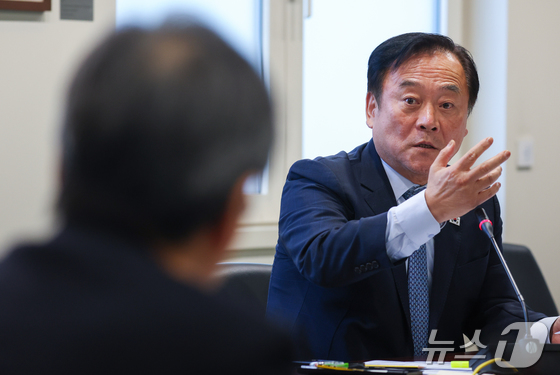
The current administration and ruling party are pushing to lift access restrictions on 60 North Korean websites, including Rodong Sinmun and the Korean Central News Agency.
They argue that the era when exposure to North Korean media led to the glorification of the North Korean regime has passed. There’s a growing consensus on the need to ease excessive controls to protect citizens’ right to information.
Moreover, many South Koreans, including journalists and academics, have long been able to access North Korean media through virtual private networks (VPNs). This reality underscores the need to bridge the gap between law and practice.
This initiative was previously pursued as part of the national agenda during the Yoon Suk Yeol administration but ultimately stalled.
On December 19, during a Ministry of Unification briefing, President Lee Jae Myung effectively ordered the comprehensive opening of North Korean information, accelerating subsequent measures.
Since late last month, the Ministry of Unification has reclassified Rodong Sinmun from special materials to general materials, allowing public access at over 181 locations nationwide, including the Ministry’s North Korean Materials Center and the National Library of Korea.
However, legal amendments are necessary to enable online access to North Korean websites. The bills introduced by Representatives Han Min Soo and Lee Jae Gang are expected to undergo joint review in the National Assembly soon.