

North Korea has shifted its focus from the Venezuela crisis following the Maduro incident to the Greenland issue raised by President Donald Trump. This change highlights the growing rift between the United States and the North Atlantic Treaty Organization (NATO). Analysts suggest that North Korea is employing a strategy of indirect criticism by quoting European leaders, European Union (EU) officials, and Western media, rather than directly condemning the U.S. This approach aims to underscore structural divisions within Western alliances, as reported on Tuesday.
On January 25, the Workers’ Party’s official newspaper, Rodong Sinmun, reported that various countries are voicing concerns about the Greenland issue potentially escalating tensions among Western nations to a more serious level. The report noted that high-ranking European officials are openly opposing U.S. attempts to annex Greenland.
The newspaper conveyed criticism from Denmark’s Prime Minister, who stated that other countries and their people should not be treated like commodities. The Prime Minister described the mindset of using pressure to seize foreign nations and peoples as an outdated worldview.
The report emphasized the backlash from EU leadership. The European Commission President insisted that the rule of law is stronger than power and demanded respect for Denmark and Greenland’s territorial sovereignty. The President of the European Council criticized U.S. territorial ambitions, stating that matters concerning Denmark and Greenland cannot be decided without the parties involved.
The newspaper actively relayed critical assessments from Western media and experts. It reported that The Wall Street Journal evaluated U.S. threats towards European countries resisting the annexation of Greenland as pushing Western alliances into their greatest crisis. Experts warned that the situation could evolve unpredictably, potentially leading to catastrophic consequences.
These reports suggest that North Korea is strategically using information warfare and propaganda to highlight fractures within Western alliances, rather than resorting to military or diplomatic interventions. By quoting European leaders, EU officials, and Western media instead of directly criticizing the U.S., North Korea aims to avoid direct conflict while increasing anti-American sentiment among its citizens – an indirect offensive strategy, according to analysts.
Previously, North Korea strongly condemned U.S. airstrikes at the outset of the Venezuela crisis through the Korean Central News Agency (KCNA), calling them the most serious form of sovereignty infringement. However, since January 15, it has effectively ceased related reporting.
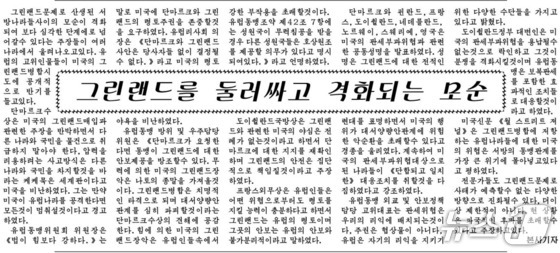
In contrast, since January, Rodong Sinmun has expanded its coverage of the Greenland issue, consistently highlighting U.S.-Europe conflicts. On January 7, it reported that Denmark’s Defense Intelligence Service classified the U.S. as a potential security concern for the first time in history. It cited European polls and Western media reports indicating growing public perception of the U.S. as an unreliable and destabilizing nation.
On January 8, it quoted an EU spokesperson asserting that Denmark and Greenland’s sovereignty and territorial integrity must be respected. From January 15 to 16, it continued reporting on condemnations of U.S. annexation ambitions by Danish, German, and Greenlandic officials. On January 17, under the title, Deteriorating Alliance Relations, it focused on the instability in U.S.-Europe alliances. From January 18 to 20, it highlighted fractures within both the U.S. and Western alliances by quoting Russian officials and dissenting voices in the U.S. Congress.
Since January 22, it has actively reported external assessments that U.S.-European relations are facing their most serious crisis since World War II, citing European poll results, statements from the French President, and declarations from EU leadership.