

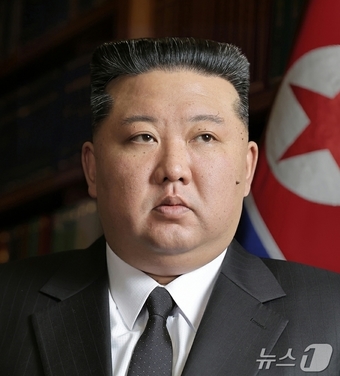
Kim Jong Un, the General Secretary of North Korea’s Workers’ Party, announced a hardline stance to completely reject and disregard South Korea during the Supreme People’s Assembly, North Korea’s equivalent of a national legislature.
On Tuesday, the party’s official newspaper, Rodong Sinmun, reported that the second day of the first session of the 15th Supreme People’s Assembly took place on Monday, detailing Kim’s policy speech.
Kim emphasized that the government of the Republic will resolutely strengthen its position as a nuclear power and aggressively wage a struggle against all anti-Republic provocations from hostile forces. It will not tolerate any actions by forces attempting to infringe upon the sovereign rights, security interests, and right to development.
He further declared that it will officially recognize South Korea as the most hostile nation and will deal with it by thoroughly rejecting and ignoring it through unequivocal words and actions. It will ensure that any South Korean actions that interfere with the Republic face severe consequences without the slightest consideration or hesitation.
Kim noted that in today’s world, unpredictability is the only predictable outlook, and stated that for peace to be a choice of the strong rather than a sign of weakness, it must be backed by formidable power.
He asserted that the Democratic People’s Republic of Korea has never rejected peace and has never neglected efforts to secure the most reliable means of preserving peace from a peace-loving stance. He emphasized that this approach is not only about ensuring North Korea’s own security but also about guaranteeing lasting peace and stability for the region and the international community.
Kim justified strengthening nuclear capabilities, stating that in line with the mission entrusted by the Constitution of the Republic and the demands of the national nuclear force enhancement policy, it will further expand and evolve the self-defensive nuclear deterrent. It will ensure our nuclear forces are fully prepared to manage strategic threats to national and regional security.
He claimed that while the U.S. engages in state terrorism and acts of aggression worldwide, its arrogant coercion and audacity have not suppressed the will of progressive humanity to oppose domination and subjugation. Instead, they have ignited anti-American sentiment and hatred among self-reliant forces, pushing them toward unity and resistance. Kim added that the construction of a fair and just multipolar world would be more vigorously promoted.
However, it remains unclear whether the concept of hostile two states has been incorporated into the Constitution. The newspaper only reported that Jo Yong-won, the Chairman of the Supreme People’s Assembly, presented information on constitutional amendments as the fourth agenda item.
The reporter argued that amending and supplementing the Constitution of the Republic, which serves as the legal foundation and political charter for the dignity and sovereignty of the nation and its people, marks a groundbreaking milestone in legally guaranteeing the victorious advancement of socialist construction and the cause.
Additionally, the newspaper reported that the Socialist Constitution of the Democratic People’s Republic of Korea has been renamed to the Constitution of the Democratic People’s Republic of Korea and provided a detailed explanation of the amended and supplemented draft law.
Kim had previously officially declared inter-Korean relations as hostile two states at a party plenary meeting at the end of 2023.
Following this, he implemented physical separation measures such as severing inter-Korean roads and railways and erecting fences and barriers near the military demarcation line. Observers suggested that institutional follow-up measures would be necessary in light of the 9th Party Congress held last month.
In January 2024, the Supreme People’s Assembly directed the creation of constitutional provisions defining territory, territorial waters, and airspace, but North Korea has yet to disclose related details.
The Supreme People’s Assembly, as the highest sovereign body under North Korean law, plays a role in formalizing the Workers’ Party’s decisions into state institutions such as the Cabinet. The newspaper reported that on the first day of the meeting held on March 22, they discussed three agenda items: the election of the Chairman of the State Affairs Commission, the election of national leadership institutions, and the election of the Supreme People’s Assembly’s sectoral committees.