

North Korea has initiated a modernization program for its aviation infrastructure, focusing on renovating key airport runways in tourist areas along the East Sea coast and near the Chinese border. Defense analysts suggest this effort is part of a dual-purpose strategy, aiming to bolster both tourism development and military capabilities rather than simply expanding civilian air travel.
According to a report by NK News on Thursday, based on satellite imagery analysis from Planet Labs, North Korea is currently upgrading runways at three strategic locations: Wonsan Kalma International Airport, Uiju Air Force Base near Sinuiju, and Samjiyon Airport.
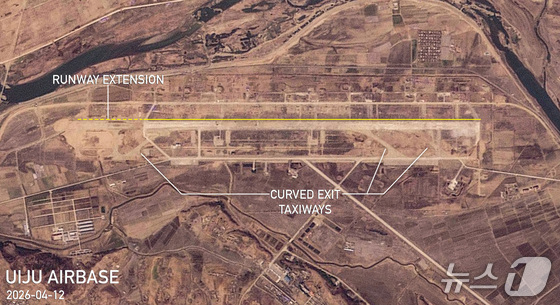
The renovation projects at these airports involve installing or expanding angled taxiways on their runways. These specialized taxiways allow aircraft to exit runways more efficiently after landing, without significantly reducing speed. This design enhancement improves overall airport operational efficiency by reducing intervals between takeoffs and landings.
This development marks a significant departure from the typical right-angle exit structures found at most North Korean military airfields, which require aircraft to make sharp turns. Given the limited civilian air traffic within North Korea, NK News assesses that these upgrades are more likely aimed at enhancing the dual-use capabilities of these airports during potential conflict scenarios, rather than merely improving commercial flight operations.
The most notable site undergoing renovation is the Uiju Air Force Base. Historically used for Soviet-made IL-28 bombers, this base was repurposed as a quarantine and disinfection logistics hub during the COVID-19 pandemic. Reports indicate it resumed its military airfield functions in late 2022. Satellite imagery reveals that runway expansion work commenced in November 2022, extending the runway from approximately 2,500 meters to about 3,000 meters (about 8,202 ft to 9,842 ft). This extended length, surpassing that of typical North Korean air bases, has led to speculation about the facility’s potential to accommodate larger cargo aircraft and medium-sized military planes.
At the Uiju base, construction also includes new connecting roads between the taxiway and external thoroughfares. The project appears to be part of a larger-scale development initiative in the surrounding area. Notably, this region was personally inspected by Kim Jong Un following flood damage last year, fueling discussions about its potential as a future logistics and transportation hub or as part of a comprehensive development plan.
Wonsan Kalma International Airport has been undergoing runway expansion and taxiway improvements since March. The project involves widening the intersection between two runways – measuring approximately 3,500 meters (about 11,482 ft) and 3,120 meters (about 10,236 ft) respectively – and adding an angled exit taxiway at the southeastern end of the longer runway.
The upgrades at Wonsan Airport seem timed to enhance tourism infrastructure ahead of the peak summer season, marking the second summer since the opening of the Kalma Coastal Tourist Area. Given that Wonsan Airport has operated with minimal international flights for nearly a decade, these improvements could be preparatory measures for an anticipated increase in Chinese tourist arrivals, reflecting improving North Korea-China relations. Reports also indicate concurrent construction of a major new railway station in the vicinity.
Samjiyon Airport is also undergoing a runway expansion project. Initiated last year, the work includes adding an angled exit taxiway to the approximately 3,300-meter (about 10,826 ft) runway. This project is being carried out alongside the development of a high-speed rail line connecting the airport to downtown Samjiyon and nearby ski resort facilities. These efforts align with North Korea’s strategy to develop the Samjiyon and Mount Paektu areas as key tourist destinations, with a strong emphasis on improving accessibility.
However, defense experts caution against interpreting these airport modernization efforts solely as tourism-driven initiatives, given North Korea’s limited civilian aviation demand. With Pyongyang’s Sunan Airport currently being the only facility handling international flights, and domestic air travel remaining highly restricted, the extensive runway expansions and airport upgrades likely serve dual civilian-military purposes.
NK News concludes that while North Korea publicly emphasizes tourism and civilian infrastructure development, these projects likely serve a dual purpose: enhancing wartime aviation capabilities and expanding capacity to accommodate large military aircraft and logistics operations.