

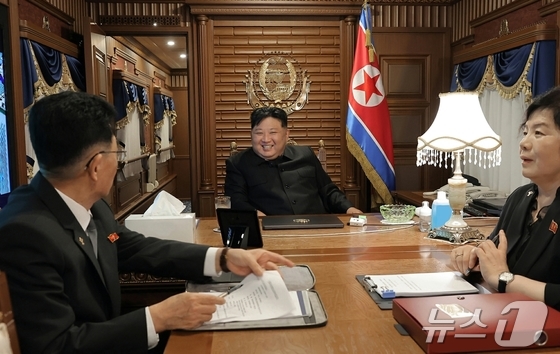
On Monday, analysts proposed that North Korea has consolidated its foreign and inter-Korean strategies, centralizing them around Kim Jong Un (Kim), the General Secretary of the Workers’ Party, following the 9th Party Congress and the 1st Plenary Session of the 15th Supreme People’s Assembly. It is expected that key officials will assume foreign affairs roles in both the Party and state organizations, with their responsibilities divided by function and country to implement policies effectively.
Kim Il-ki, Director of the North Korea Research Department at the National Security Strategy Institute, outlined in a report titled, North Korea’s Foreign and Inter-Korean Strategic Planning for the 9th Party Congress and the 1st Plenary Session of the 15th Supreme People’s Assembly, that under Kim’s leadership, Kim Yo-jong, head of the Party’s Organization and Guidance Department, will oversee foreign affairs. Policy execution is likely to be handled by Kim Song-nam, the International Secretary of the Workers’ Party and Chairman of the Supreme People’s Assembly’s Foreign Affairs Committee; Choe Son-hui, the Foreign Minister and a member of the Party’s Politburo; and Jang Kum-chol, the First Vice Minister of Foreign Affairs and head of the Party’s 10th Department.
Based on their past experiences, analysts predict that Kim Song Nam will lead relations with socialist countries like China, Choe will manage interactions with the U.S., Russia, and non-socialist nations, and Jang will spearhead inter-Korean affairs.
Kim Il-ki noted that this dual-role structure among these officials reflects an intent to ensure cohesive execution of foreign policy. This approach aims to minimize discrepancies between the Party’s strategic directives and the government’s implementation, thereby enhancing the consistency of foreign policy.
Of particular interest is Jang’s evolving position. Historically, North Korea has not granted foreign ministry titles to those overseeing inter-Korean affairs, making Jang the first individual in this role to hold both titles. This change suggests that North Korea is transitioning its inter-Korean strategy to a state-to-state framework, allowing for a more unified approach to foreign policy from their perspective.
It is also uncommon for the Party’s International Secretary to concurrently serve as the Chairman of the Supreme People’s Assembly’s Foreign Affairs Committee. Previous examples of such dual roles include Hwang Jang-yop and Ri Su-yong (former Foreign Minister).
Last month, during a summary report, North Korea unusually emphasized the Party Central seven times in the context of foreign strategy, highlighting Kim’s direct leadership and involvement in foreign policy. Analysts interpret this as reflecting Kim’s recognition of the unpredictable changes in international and Korean Peninsula dynamics, which he views as crucial for North Korea’s survival and development.
Director Kim also emphasized the importance of the roles played by Jo Yong-won, Chairman of the Standing Committee of the Supreme People’s Assembly, and Kim Tok Hun, First Deputy Prime Minister, in the diplomatic sphere.
Given that the Chairman of the Standing Committee plays a constitutional role as a head of state, Kim interprets Jo’s appointment not as a demotion but as a strategic move under Kim’s direct guidance in foreign affairs. Additionally, the position of First Deputy Prime Minister is newly established this year, with Kim Tok-hun expected to oversee foreign economic exchanges and cooperation. He is also anticipated to serve as the Deputy Chairman of the Supreme People’s Assembly’s Foreign Affairs Committee, managing economic cooperation with China and Russia, among other countries.
Director Kim predicts that North Korea may shift away from its previous strategy of interlinking U.S.-North Korea and inter-Korean relations, instead pursuing both tracks separately. Consequently, even if negotiations with the U.S. progress, initial advancements in inter-Korean relations could be limited, potentially constraining the South Korean government’s ability to implement its North Korea policies.
However, analysts forecast that if U.S.-North Korea negotiations advance in the medium to long term, issues regarding compensation for North Korea may resurface during the denuclearization or relationship improvement processes. This could necessitate South Korea’s participation, potentially bearing a significant portion of the costs, according to Director Kim.