

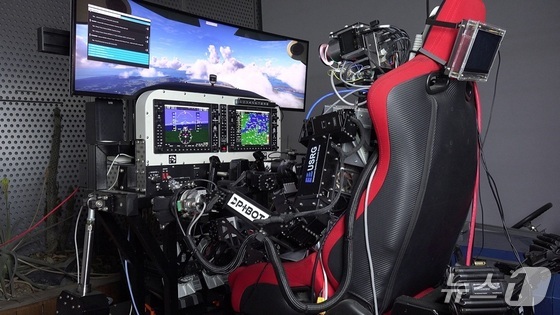
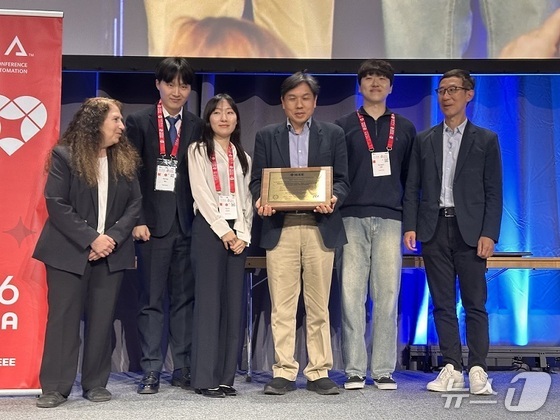
Korea Advanced Institute of Science & Technology’s (KAIST) Professor Shim Hyun-cheoland his research team have achieved a remarkable milestone in robotics. Their paper on the humanoid pilot robot PIBOT and its autonomous aircraft control framework has been awarded the Best Paper Award by the 2025 IEEE Robotics and Automation Magazine (IEEE RAM), as announced on Friday.
PIBOT represents a groundbreaking advancement in robotics. This humanoid robot is meticulously designed to mimic human body structure and piloting movements, enabling it to physically operate conventional aircraft interfaces such as joysticks, switches, levers, and pedals.
This prestigious recognition underscores the global impact of South Korean technology and independent research in the cutting-edge field of robotics. The award ceremony was held on Thursday during the International Conference on Robotics and Automation (ICRA) in Vienna, Austria.
IEEE RAM, a highly respected publication of the IEEE Robotics and Automation Society (RAS), boasted an impressive impact factor of 7.1 in 2025. This places it as the second most influential journal worldwide in the robotics domain.
The research received substantial backing from the Defense Acquisition Program Administration’s (ADD) Future Challenge Defense Technology research and development (R&D) project, with funding of approximately 57 billion KRW (36.88 million USD) over five years. The team successfully completed the initial phase of the study in 2021. Currently, they are developing the second-generation pilot robot, designed with human-like physique and joint structure for practical flight applications, set to commence in 2024.
Professor Shim expressed his enthusiasm, stating that its pioneering pilot robot technology has garnered global acclaim, thanks to the support of a major domestic project. It’s committed to advancing the research to ensure humanoid robots can safely assist people and operate systems in real-world scenarios.
The groundbreaking paper was co-authored by doctoral students Min Seong-jae, Kang Gyu-ri, and Kim Hyung-joo as co-first authors, with Professor Shim as the corresponding author. For those interested in delving deeper into this innovative research, the full results are accessible through IEEE Xplore.