

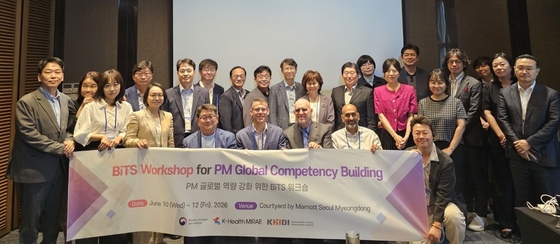
The K-Health Future Initiative at the Korea Health Industry Development Institute (KHIDI) has completed its first specialized training program designed to strengthen the capabilities of program managers (PMs) leading Korea’s ARPA-H-style research projects.
The initiative said on June 15 that it operated the Global Program Manager Talent Development Course (BiTS) from June 10 to 12.
BiTS, short for Big if True Science, is a program manager training framework used by ARPA-style research organizations in the United States, including the Defense Advanced Research Projects Agency (DARPA), the Advanced Research Projects Agency for Health (ARPA-H), and the Advanced Research Projects Agency-Energy (ARPA-E).
The program is designed to help scientists and engineers transform ambitious research concepts into large-scale research and development initiatives through practical, mission-driven training.
Since its launch in 2024, the K-Health Future Initiative has recognized the need to cultivate program managers capable of leading mission-oriented, high-risk, high-reward research projects. After reviewing training methodologies used by U.S. ARPA-style agencies, it introduced the BiTS program in Korea for the first time.
The training was attended by program managers and operational staff from the initiative.
The curriculum focused on ARPA-style R&D philosophy, the Heilmeier Catechism framework, milestone setting and management, risk management, technology transfer and commercialization strategies, and the development of international innovation networks.
The program was led by experienced experts, including former DARPA program manager Jean-Paul Chretien, former DARPA Biological Technologies Office program manager Leonard M. Tender, and Sandeep Patel, the founding director of DRIVe at the U.S. Biomedical Advanced Research and Development Authority (BARDA).
Jean-Paul Chretien, who served as the program’s lead instructor, said more ARPA-style research programs and highly capable program managers are needed to tackle major societal challenges.
“I was able to see the expertise and determination of the K-Health Future Initiative’s program managers, and I expect their efforts will contribute to solving critical challenges in future healthcare,” he said.
Sun Kyung, director of the K-Health Future Initiative, said the success of challenge-driven and innovative R&D programs depends heavily on the planning and management capabilities of program managers.
“This BiTS training program has provided a foundation for strengthening practical capabilities, and we hope our program managers will play a central role in expanding Korea’s culture of challenge-driven and innovative research and development,” Sun said.
Meanwhile, the Korean ARPA-H project is a national R&D initiative designed to address major healthcare challenges through high-risk, high-impact research. The program was modeled in part on U.S. ARPA frameworks, including DARPA.
The initiative focuses on five mission areas: strengthening health security, overcoming diseases with unmet medical needs, securing breakthrough biohealth technologies, improving welfare and caregiving systems, and building regionally self-sufficient essential healthcare networks. It prioritizes support for research projects that are difficult to execute but have the potential to generate significant societal impact.